




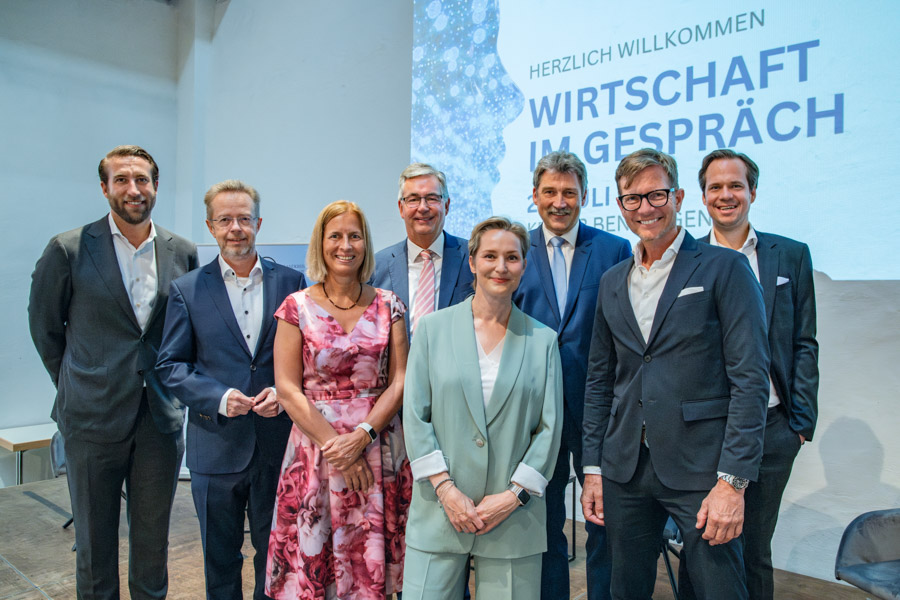
Digitalization is both an opportunity and a challenge for companies in the Ludwigsburg district. The participants in the panel discussion supported by Kreissparkasse Ludwigsburg and the municipality of Benningen at the "Wirtschaft im Gespräch" event on Tuesday evening in the Alte Kelter in Benningen agreed on this: digitization can make processes more efficient, help to reduce the problem of skilled workers and be a key technology for opening up completely new business sectors and business models. District Administrator Dietmar Allgaier said: "I am pleased to see that there are already many good examples of how artificial intelligence can be used in companies in our region. I am also optimistic about the economic future of our district thanks to the innovative strength and close exchange within the company network."
Digitalization is changing products, but also business models and companies
Dr Tanja Rückert, member of the Board of Management and responsible for digitalization at the Bosch Group, is convinced of the great opportunity offered by artificial intelligence in particular. "If we take the emerging changes seriously today and deal with them constructively, artificial intelligence in particular can provide positive impetus for the German economy. That's why the Ludwigsburg district's initiative is important to make companies even more aware of this." Using Bosch as an example, Rückert showed how digitalization is not only changing products, but also business models and the company itself. With many examples, for example from automated driving, quality inspection and customer service, she was able to convince the guests of the potential of AI, which Bosch is working hard to tap into.
Artificial intelligence is used to remain internationally competitive
In the subsequent panel discussion, the focus shifted to SMEs. While the majority of the audience in the live survey stated that they were driven by digitalization, York Boeder, Managing Director of the medium-sized paint manufacturer Marabu, clearly sees his company as a driver. Marabu uses artificial intelligence to develop new color mixtures, for example, by analyzing existing knowledge in various areas and making it available to developers. In this way, the company is trying to remain internationally competitive.
Together with Dr Benjamin Strehl, CEO of USU Software AG, IHK President Julian Pflugfelder and Dr Tanja Rückert, Boeder discussed the pros and cons of digitalization. The panellists agreed that digitalization also affects smaller companies, but that they suffer even more from the lack of specialists with IT expertise and usually lack the resources to develop new business models and process improvements in a targeted manner, following Bosch's example. The panel emphasized the importance of school education and dual training for the next generation and for the expansion of IT skills in companies. In addition, young people should also be made more aware of these topics and promising career profiles. All panel participants agreed on one point: getting employees excited about the use of AI and training them accordingly is one of, if not the most important building blocks for their success in a company.
District Administrator Dietmar Allgaier was satisfied with the response from companies to "Wirtschaft im Gespräch". SMEs are dependent on networks and mutual learning, especially when it comes to new topics such as artificial intelligence. Even if there is still a lot of work to be done in business and politics and IT specialists are hard to find, the examples shown encouraged people to face up to the challenges, said the district administrator. The district and district economic development officer Oliver Reichert want to make a small contribution here and continue the series of events next year.