



Debt counseling in the district of Ludwigsburg is offered not only by the district administration's debt counseling service, but also by independent providers, the Kreisdiakonieverband Ludwigsburg and the Sozialberatung Ludwigsburg e.V. social counseling service.
Debt counseling has the task of advising privately over-indebted individuals and families. In consultation with these individuals, negotiations are conducted with creditors in order to bring about a settlement of the debt. Debt obligations are to be settled by means of composition agreements and repaid through monthly installments paid by the debtor.
- Debt counseling with the attempt to reach an out-of-court agreement with creditors by settling debts by means of compromise agreements, taking into account the entire family situation
- Prior to debt counseling, clarification of the situation as part of the open consultation hours of the debt counseling service of the Ludwigsburg District Office
- Involvement of the debtor, e.g. in the preparation of a budget plan or in the planned division of the family income
- Implementation of proceedings in accordance with the Insolvency Code (InsO). The debtor counseling service of the District Office is a suitable office in accordance with § 305 InsO and in this context is authorized to carry out out-of-court settlement attempts with the aim of drawing up a debt settlement plan.
- If an account has been seized and a seizure protection account has subsequently been set up with the bank, we are authorized to issue certificates for persons receiving advice from us in order to obtain an allowance in excess of the basic amount.
- If the out-of-court settlement attempt fails, we can also file an insolvency petition with the court
In order to be able to provide advice, including during open consultation hours, you must complete and sign our questionnaire and data protection consent form. You can download the questionnaire and data protection consent form (see below) and then complete it and return it to us by post. You can also request the questionnaire from us by telephone or e-mail or collect it in person during office hours (see below). Once you have submitted the questionnaire and your complete documents, you will have the opportunity to discuss the next steps in our open consultation hours. This takes place regularly on Mondays between 8:30 am and 11:00 am and 1:30 pm and 3:30 pm (except on public holidays). Please bring the following documents with you: Tenancy agreement, bank statements for the last 3 months, proof of income (payslips, ALG II notice, child benefit etc.), letters from creditors (sorted by creditor and date), loan agreements.
Waiting times must be expected before admission to the actual debt counseling. In urgent cases, the debtor can instruct a lawyer. To ensure that the debtor does not incur any costs that cannot be paid, it makes sense in this case to apply for a counseling assistance certificate from the local district court.
All employees of the advice centers are subject to the statutory duty of confidentiality and social data protection.
Data will not be passed on without the client's consent.
Any evaluation of data by the debt counseling service only takes place within the framework of the provisions of the Social Security Code and the State Data Protection Act.
Please contact the debt counseling office:
Hindenburgstraße 46 III. OG
71638 Ludwigsburg
Tel. 07141 144-2468
Fax: 07141 144-59413
schuldnerberatung
Links to the debt counseling of the social counseling or Kreisdiakonieverband
www.sozialberatung-ludwigsburg.de
www.kreisdiakonieverband-lb.de
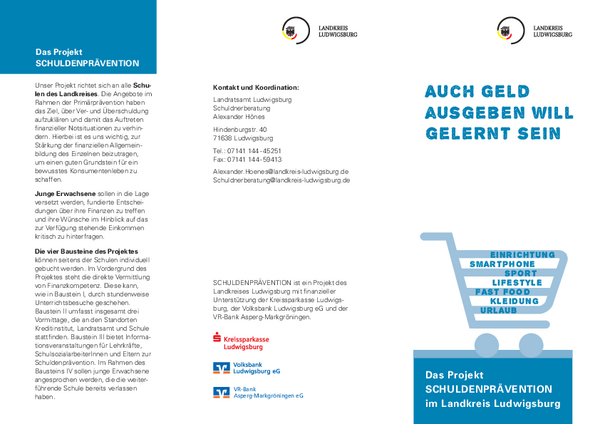
The debt prevention project in the district of Ludwigsburg
Aims of the project
The aim is to enable children and young adults to make informed decisions about their finances and to critically question their wishes with regard to their available income.
The Ludwigsburg district project is a free service for all schools in the district and can be adapted to the individual situation of the class. The aim of the services is to raise awareness of indebtedness and over-indebtedness and thus prevent the occurrence of financial emergencies. It is important to us to contribute to strengthening the general financial education of the individual in order to create a good foundation for a conscious consumer life.
The four modules of the project can be booked individually by the schools. The project focuses on the direct teaching of financial literacy
Module I: Classroom visits to secondary schools
The debt counseling service visits school classes from grade 7 onwards and teaches financial literacy with different focal points. These are discussed with the responsible teacher and individually adapted to the needs of the respective class. The time frame comprises 2 to 5 school hours.
Module II: Two-day debt prevention project with secondary schools
Two-day (mornings) projects for pupils from grade 8 onwards. One day takes place at the Ludwigsburg district office and one day at the school.
Possible content for the two-day project:
- The first own apartment with household and budget planning
- Dealing with your own money (account, loans, EC card, online banking)
- APPs and rip-offs
Module III: Information events for teachers, school social workers and parents
As part of school events (parents' evenings, general teacher conferences) or information events for school social workers in the district office, the offers and possibilities of the prevention project should be presented and explained. If required, information can also be provided on the possibilities and tasks of debt counseling.
Module IV: Offer for young people from vocational schools
Debt counseling visits vocational school classes to work with young adults on topics that are relevant to their lives and pose initial debt risks, such as their first home. The teaching content on financial literacy can have different focuses. These are discussed with the responsible teacher and individually adapted to the needs of the respective class.
The design of the project
The spatial and technical framework conditions for the design of the project are agreed with the participants.