



The extreme summers of 2018 and 2019 also left deep wounds in the forests of the Stromberg. "We hadn't expected the extensive damage to the Scots pine, as it is considered a comparatively drought-tolerant tree species. The pines in Stromberg survived the summer of 2003 unscathed," says district manager Theo Wöhr. In order to clarify the causes of the death of the Scots pine and to develop recommendations for further treatment, a bachelor's thesis was tendered in cooperation with the Rottenburg University of Forestry.
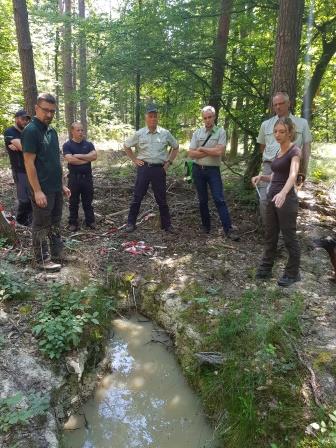
Vivian Beschmann took on the task of working on this challenging issue, and the bachelor's thesis was supervised by Prof. Stefan Ruge, who holds the Chair of Botany and Silviculture Fundamentals in Rottenburg. Beschmann passed on the main results of her work to the Ludwigsburg foresters as part of a presentation including an excursion to the Vaihingen city forest.
"As part of my research, I was able to establish a clear correlation between the amount of water available to the trees at a specific location and the occurrence of dieback," said Beschmann. This result was to be expected. However, other results of the work were surprising: "We were also able to establish a direct correlation between competition with sessile oaks and the death of the Scots pine, which was inferior in this case. In all the soil profiles studied, it was found that the sessile oak has significantly deeper roots than the Scots pine and is therefore better able to reach water in direct competition with it. In contrast, the pine was more vital without direct competition from the oak," is another conclusion of their work. Mixed forests are generally good for the forest itself, but not necessarily for every tree species, in this case the Scots pine.
"It was also possible to demonstrate a significantly different distribution of precipitation in the study area compared to 2003, which can presumably be identified as the main cause of the dieback," continued Beschmann. Prof. Ruge added: "With a few exceptions, our native tree species are not adapted to prolonged drought and heat. Accordingly, it is absolutely essential to carry out research here in order to precisely sound out the actual potential of our native tree species and also to examine possible alternatives in particularly warm and dry locations." The Scots pine is not only struggling with the drought, the heat of recent summers is also increasingly causing the tree species problems.
Fortunately, there are also species in the pine family, such as the black pine, which can cope well with both heat and drought and therefore represent a possible alternative to Scots pine. This means that the current mixed forests in Stromberg, consisting of oak, beech, Scots pine and some more, can continue to exist in an only slightly modified form by planting black pines.
"Cooperation with scientific institutions and the promotion of young talent are very important to us. This allows us to keep our knowledge up to date and apply the latest research findings directly to our daily work," explained Nill in conclusion. "At the same time, students are given the opportunity to carry out practical research on currently relevant topics."