



District Administrator Dietmar Allgaier was delighted with the high funding rate, which Andreas Zahn, Head of the Railways and Rail Infrastructure Department at the Baden-Württemberg Ministry of Transport, explained in his speech. The District Administrator said: "The reactivation of the line from Markgröningen to Ludwigsburg is a crucial first step. You have heard first-hand today what a high funding rate we can expect. I am convinced that as soon as the light rail system is running there, it will win over new people day after day - through its practical benefits, its reliability and its contribution to the transport revolution. And it will also create the trust and social basis for the next expansion steps."
Results of the benefit-cost assessment
The benefit-cost indicator (BCI) for the pre-carriage operation between Markgröningen and Ludwigsburg station (track 6) is 1.1. To explain: if the BCI value is greater than 1, the benefits of a transport project are higher than its costs; if such a project achieves a value between 0 and 1, the benefits are generally classified as positive, but they cannot fully compensate for the costs of implementing the infrastructure project in question. If the NKI value is below 0, the running costs are higher than the benefits.
With an NKI value of 1.1, the alternative route with the looping of the train over the signal box and the stop at the west exit of the station performs better than the stop in the station on track 6 with an NKI value of 1.6. "It enables savings in bus services, shortens travel times for passengers and noticeably reduces car traffic," explained Max Bohnet from Gertz Gutsche Rümenapp Stadtentwicklung und Mobilität GbR Berlin. "The advantage of the alternative route is also evident in the overall network with the connections to Schwieberdingen, Oßweil and Pattonville: while the original decision route achieves an NKI of 1.0, the alternative route achieves 1.2. This clearly underlines the overall economic benefits of the project."
Advantages for the region
Forecasts show that even in the first expansion stage, around 8,000 passengers will travel on LUCIE every day. This will shift around 6.5 million kilometers a year from car to rail. "In addition to relieving road traffic, the project makes an important contribution to climate protection, as CO₂ emissions are reduced. At the same time, local residents will benefit from better accessibility and a higher quality of life," continues Bohnet.
Financing and funding
The construction and planning costs are largely covered by federal and state funding. "Local authorities contribute a manageable amount to reactivations. This means that there is a broad basis for solid financing together with the federal and state funding for the project," said Head of Department Zahn from the Ministry of Transport.
Only with Ludwigsburg can the first step for the light rail be realized
"I know how tight the budget situation is - especially in Ludwigsburg. I know about the difficult debates in the local council and among the citizens. Because every saving, every cut, every increase in charges affects people directly, provokes opposition and requires a lot of persuasion," says District Administrator Allgaier. "Starting an infrastructure project like the light rail system at this time is a major challenge for all of us. But I am sure that we can start it together." Only if Ludwigsburg joins in, stays and helps shape the project can LUCIE be kept as a promise for the future for everyone. "We therefore take the concerns and issues of the city of Ludwigsburg very seriously and want to involve the city as much as possible, because it's not just facts and figures that are needed. Rather, it is crucial that we present a united and reliable front - and actively involve the citizens, especially local residents."
Background: About the elected representatives' forum
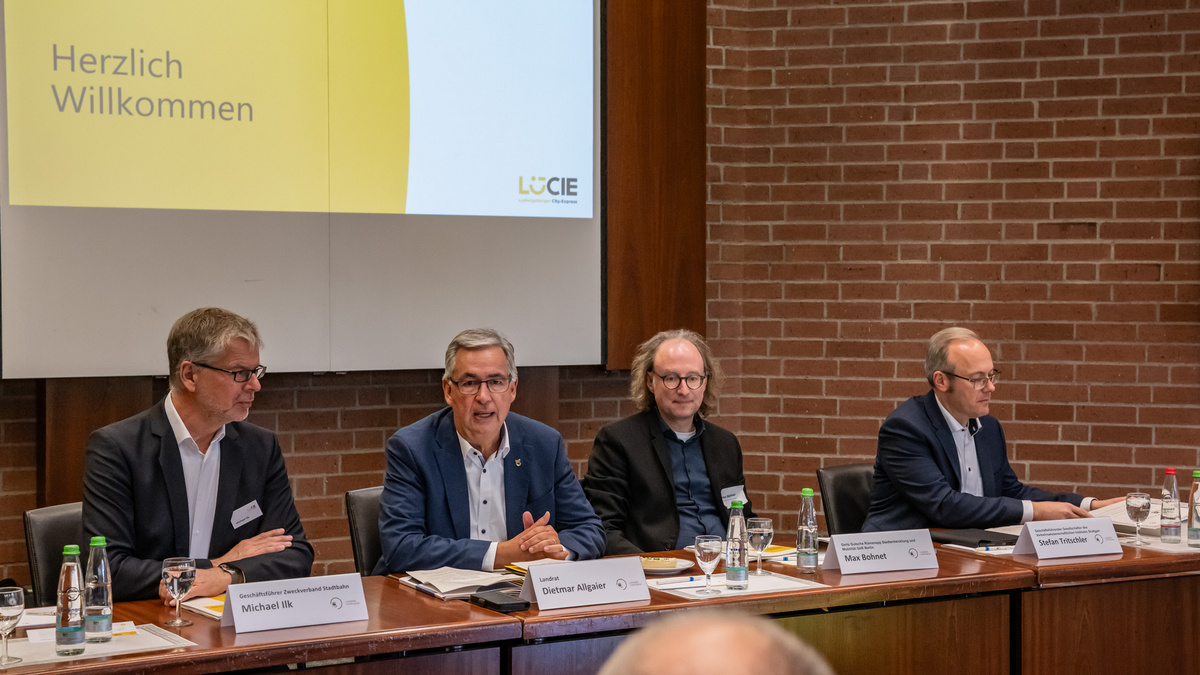
The members of the administrative board of the Stadtbahn special-purpose association as well as the local councillors of the member municipalities and the district councillors were invited to the elected representatives' forum. Around 100 of them took the opportunity to find out first-hand about the results of the benefit-cost analysis. In addition to Michael Ilk, Managing Director of the Zweckverband Stadtbahn, speakers included Stefan Tritschler, Managing Partner of the Verkehrswissenschaftliches Institut Stuttgart (VWI), and Max Bohnet from Gertz Gutsche Rümenapp Stadtentwicklung und Mobilität GbR Berlin, who provided information on the benefit-cost analysis, also known as the standardized assessment. Andreas Zahn from the Baden-Württemberg Ministry of Transport also explained the funding framework, while Mayor Andreas Ringle from Heilbronn reported on his experiences with the city's light rail system and its construction. Professor Markus Schmidt from the Stuttgart University of Applied Sciences moderated the elected representatives' forum.