



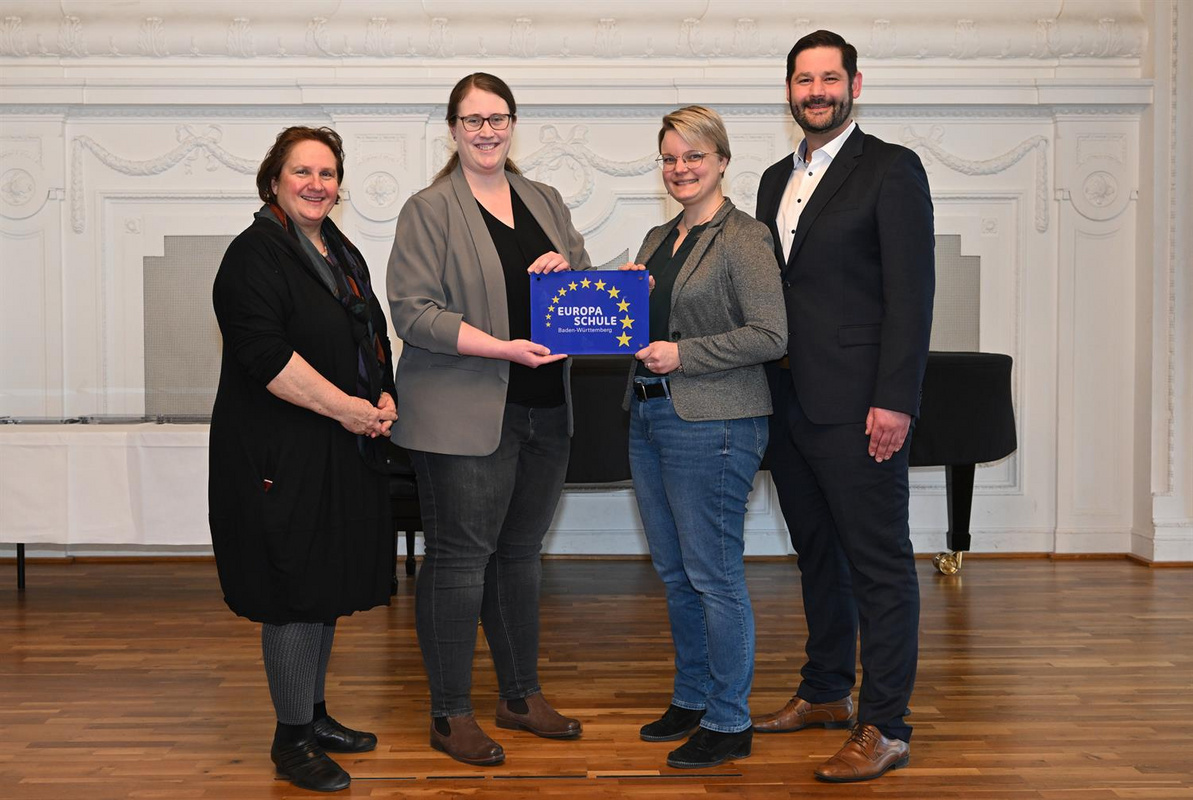
Fifty schools from all regions of the state were invited to Stuttgart to receive the blue badge with the European star wreath from the Minister of Education, Theresa Schopper. The Robert Franck School impressed the jury with its well thought-out project plan and can now bear the illustrious title of "European School".
The award-winning schools should be beacons of European values and ideas and be particularly committed to communicating them. With innovative ideas and projects, they should give a special impetus to European education in their environment and have a regional impact. The aim is to create a nationwide network that is consolidated and expanded through regular exchanges between the participating schools and support from the Ministry of Education and Cultural Affairs.
In her opening speech, Minister Schopper quoted one of the founding fathers of the EU, Robert Schuman: "You don't become a European by birth, but by education." Schools therefore have a special responsibility to teach young people about the European political project. This is by no means an easy task, as political scientist Monika Oberle illustrated in her keynote speech. Surveys of teachers showed that the immense complexity of the European political apparatus is seen as the greatest difficulty in teaching in schools. Oberle, a political didactics expert, has developed simulation games in which primary school children can simulate the European Council of Ministers and work out majority decisions themselves. She advocates intensive further training for teachers, who are currently facing new challenges when it comes to Europe. Political education should explicitly not remain neutral and free of opinion, but must be clearly committed to the free and democratic basic order. Pupils should learn at school to engage critically and constructively with their European identities.
The award-winning schools now have three years to implement their action plans and bring the title of "European School" to life. European work is to take shape creatively and in a variety of ways both in and outside the classroom. Some points in the Robert-Franck-Schule's action plan have already been tested and approved, such as the "Celebration of Diversity" or the traditional visit of the Year 13 classes to the European Parliament in Strasbourg. However, many new ideas and plans will further sharpen the profile of the European School: Action days for democracy education, organized in cooperation with the State Center for Political Education, "couch talks" to bring pupils together with a wide variety of political actors and contemporary witnesses, visits to the Stuttgart State Parliament and Nazi memorials, social projects and much more. The declared aim of the steering group, led by Elisa Frank and Melanie Weigelt, is to involve pupils from all types of school at the Robert Franck School in the project and to provide them with a wide range of learning experiences and approaches.
"Europe must be lived," Minister Schopper demanded during the ceremony in Stuttgart. With a twinkle in her eye, her head of department assured the audience that the Ministry's support for the school project would not be limited to printing blue cups with the project logo. The careful preparation and the festive launch of the project speak for themselves. However, the practical implementation and the actual work involved must ultimately be carried out by the European schools themselves. The Robert-Franck-Schule is well positioned for this.