



Alicia Läpple, biodiversity consultant at the Ludwigsburg district office, vividly demonstrated the importance and diversity of biodiversity in the district. "Our species-rich landscape with its significant diversity of animals and plants was only created through diverse land management," explained the agronomist. Farmers in the district of Ludwigsburg make a significant contribution to preserving this diversity. The participants on this evening were interested in learning about further conservation measures that they can implement on their agricultural land.
Although fields and meadows make up a large proportion of the land, particularly in heavily populated residential areas, "citizens and local authorities can also create a lot of valuable habitat by selecting native plants that bloom at different times and using near-natural garden design. The easiest way to do this is to leave some of the lawn mowed so that herbs and flowers have a chance to grow," says Läpple. All garden owners will certainly also be interested to learn that beneficial insects - as natural antagonists for pest control - need hedges and flowering herbs.
How the highly endangered partridge can be helped
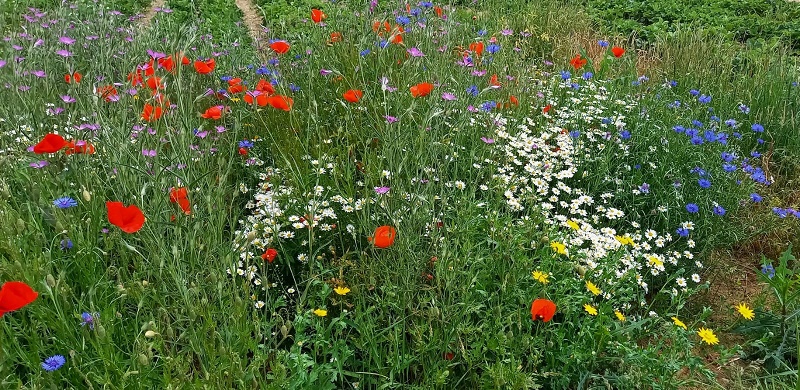
However, in the case of more demanding species, such as the highly endangered partridge, several factors come together to make the conservation of this species difficult: Habitat loss and a high risk from foxes and birds of prey, as well as unleashed dogs disturbing ground-nesting birds. Charlotte Ritter from the Ludwigsburg Landscape Conservation Association (LEV) took up the topic of partridge protection and presented the LEV's support programs to the farmers. Ritter named the creation of wildflower strips and the sowing of cereals at a greater distance as effective measures.
Farm manager Werner Zibold from Unterriexingen reported on the implementation of these two measures in practice. The wider row spacing in cereals creates breeding opportunities for partridges. In addition, undersowing with various types of clover, camelina, marigold and other herbs between the rows of grain can attract insects that serve as food for the young birds. Zibold has been committed to preserving diversity on his farmland for many years. In addition to the light fields, he has rebuilt dry stone walls in the vineyard, leaves strips of old grass on mown meadows and adapts the cultivation of rough grassland sites in order to preserve them.
The ecological potential on his land was recorded on the basis of a farm-wide biodiversity consultation. "Measures for field bird protection or targeted hedge maintenance only make sense if you know what you want to protect and the species are actually present." As a demonstration farm in the biodiversity network, Zibold also shows how biodiversity promotion can be combined with food production.
Dairy cow and regenerative agriculture at the heart of the two previous round tables
The topics of the two previous regulars' tables this winter were "Dairy cow metabolism after calving" and "Regenerative agriculture". Professor Dr. Martens from Berlin was a guest at the first regulars' table in December. An interested audience of dairy cattle farmers and dairy cattle advisors took an active part in the discussion about the correct feeding of cattle with regard to the critical period directly after calving. The conclusion of the event was that husbandry and feeding can only respond to what is already dictated by breeding.
After a Christmas break, the next regulars' table continued with "regenerative agriculture". Regenerative agriculture or regenerative farming means that the focus is on building up humus and the structure of the soil with soil life consisting of earthworms, fungi, springtails and many other creatures. Speaker Manfred Kränzler talked about his experiences, failed attempts and successful methods to promote soil life on his fields. In addition to composting manure and green waste, this also includes the use of ferments such as compost tea. Kränzler reported on further experiments with surface rotting, i.e. the very shallow but thorough incorporation of green material into the soil. It was particularly important to Manfred Kränzler that not only a lack of nutrients in the soil is a problem, but also an excess and the interactions between the nutrients must be taken into account. As in every area of life, you should never stick to your routines. "The last and most important step is to regularly check whether the methods are having the desired effect," Kränzler told the participants at the end of the evening.
Annegret Bezler, regional manager of the organic model region, is organizing the new series of events. "All farmers are invited, regardless of whether they farm organically or conventionally. The practitioners' regulars' table offers a platform for exchange between professional colleagues on a wide range of agricultural topics," explained Bezler. The regulars' tables will be continued next winter with further exciting topics.