



In October 2020, the Baden-Württemberg Ministry of Economic Affairs, Labor and Housing announced that application modules on artificial intelligence will be funded in Learning Factories 4.0 at vocational schools. The aim is to transfer modern technologies of digitalization and machine learning into today's training, to provide current Industry 4.0 solutions and digitally networked plants and systems. "Both the Carl-Schaefer-Schule and the Berufliches Schulzentrum Bietigheim-Bissingen have applied for the funding program and, fortunately, will both be considered for funding," announced District Administrator Dietmar Allgaier. The two vocational schools are run by the district.
For the Carl Schaefer School, the approval marks the first stage of the Smart Green Energy 4.0 learning workshop, which is to be expanded in the coming years. For the Bietigheim-Bissingen vocational school center, the next step in the modernization of the existing learning factory will follow as part of the funding. The measures at the schools are to be carried out in 2021 and 2022.
Project description of the Carl Schaefer School
The Smart Green Energy 4.0 learning workshop demonstrates and teaches technologies that are regenerative, resource-saving and therefore sustainable: Photovoltaics are used to harness the sun as an energy source to generate electricity. A control unit monitors and optimizes power consumption using artificial intelligence - depending on the renewable energy available. The decentralized Smart Factory 4.0 elements already present in the school (including a 3D printer, CNC lathe and milling machine) and a charging station for the electric vehicles in the vehicle workshop are connected as consumers. A total of around 24,000 euros from the school authority's own funds, around 23,600 euros in external funds and a grant from the state of around 26,500 euros are expected. The total costs amount to 74,100 euros.
Project description of the Bietigheim-Bissingen vocational school center
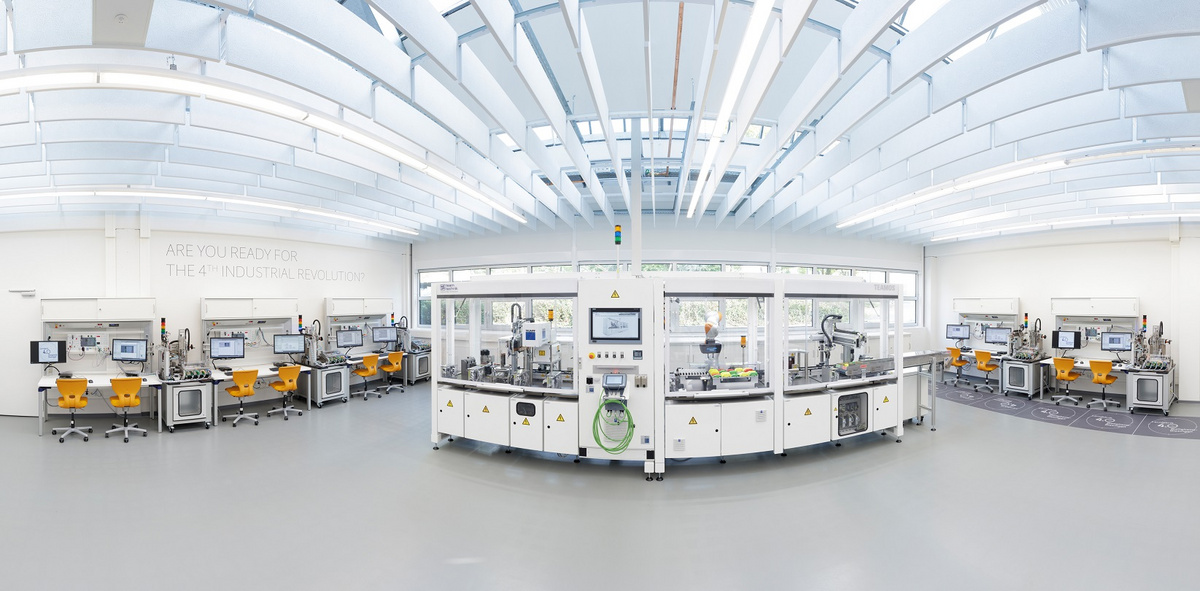
The Learning Factory 4.0, which has been in existence since 2017 and prepares for the networking of operational processes via the internet in industry, is to be upgraded in key areas. In quality inspection, a camera with AI capabilities (deep learning) will make the system more flexible and improve it. A digital twin of the basic laboratory will make it possible to teach more students and test program codes without risk. Predictive maintenance will make process parameters and fault messages accessible to the operator via augmented reality. A total of around 54,300 euros will be spent from the company's own funds and a grant of 37,500 euros is expected from the state. The total cost of the project is 91,800 euros.