



The association's administration reported to the members from the towns and municipalities of Korntal-Münchingen, Schwieberdingen, Hemmingen and Ditzingen as well as the representatives of the district council that passengers are responding very well to the modernized Strohgäubahn. However, this positive development also means that the trains are sometimes very crowded, especially during the morning peak period. These capacity bottlenecks are now to be eliminated with longer trains.
However, the RegioShuttle vehicles have not been built for several years and a successor vehicle is not currently being produced. All operators in Germany and neighboring countries are therefore dependent on the used vehicle market for capacity expansions. Now that rail transport capacity is being expanded throughout Germany, vehicles used on non-electrified branch lines are in high demand. Demand clearly exceeds supply. It is therefore all the more pleasing that the Strohgäubahn special-purpose association has succeeded in acquiring additional vehicles from the Bodensee-Oberschwaben-Bahn in Friedrichshafen, the BOB.
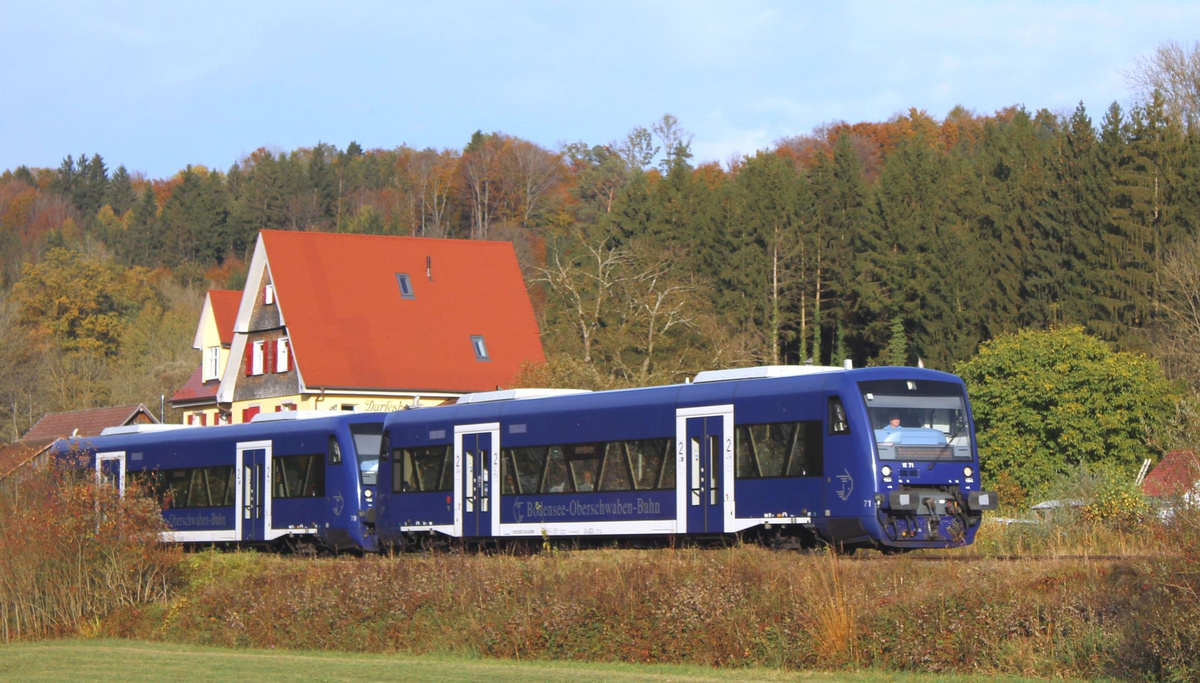
With the electrification of the southern line between Ulm and Friedrichshafen, new vehicles will be used by the BOB in future, while the RegioShuttle vehicles previously used there will be sold. Only two vehicles, like the eight existing vehicles on the Strohgäubahn, are from the latest series and are compatible with these. The Strohgäubahn special-purpose association will take over these vehicles with the designation VT70 and VT71.
Even though they are from the same series, they still need to be modified for use on the Strohgäubahn. The most important of these is the conversion of the couplings, as the existing Strohgäubahn vehicles, unlike the BOB vehicles, have automatic center buffer couplings. Further adjustments to the software control system are also necessary, and ticket vending machines must also be installed. The BOB vehicles, which are still painted blue today, will be given the Strohgäubahn design.
The vehicles are currently still in use as a reserve at Lake Constance and will be handed over to the Strohgäubahn in the course of March 2022. The necessary conversion work must be approved and accepted by the Federal Railway Authority (EBA). As the EBA is the central authority for all railroad vehicles in Germany, the work will take around 10 months in total. The costs, including the conversion, amount to 5.3 million euros. Deployment on the Strohgäubahn is planned for 2023.