



A Small Box with a Big Impact
Whenever a train travels through a curve, high forces act between the wheel and the rail. This results in friction, wear, and the characteristic squealing sound that can be perceived as disruptive, especially in densely populated residential areas.
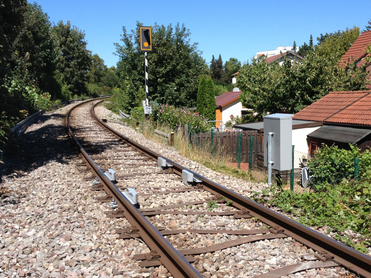
“This is exactly where the rail head conditioning system comes in. It automatically applies a precisely measured amount of a special conditioning agent to the rails. The thin film alters the friction between the wheel and the rail so that the trains run more smoothly through the curves,” explains Technical Advisor Ralf Rotermund.
A suggestion led to a pilot project
Between the Gymnasium stop and the workshop in Korntal, the Strohgäubahn runs directly alongside residential areas. Residents found the operating noise particularly bothersome in the curved sections.
Although the Strohgäubahn Special-Purpose Association was not legally obligated to take measures against the squealing in curves, the association’s assembly deliberately opted for a voluntary solution.
As part of a pilot project, the first rail head conditioning system was installed in September 2017. It sprays the rails in the area of the noise source with a special conditioning agent, the effects of which extend over a distance of approximately 300 meters.
The field test was a success
Feedback from residents was overwhelmingly positive. As a result, the project did not end with the pilot: Since then, rail head conditioning systems have been installed at three additional locations along the route.
The benefits go far beyond noise protection, explains Rotermund: “The rail head conditioning systems not only reduce noise but also minimize wear on wheels and rails. This preserves the infrastructure, improves the running performance of the trains, and helps ensure that the Strohgäu Railway can be operated reliably and economically in the long term.”