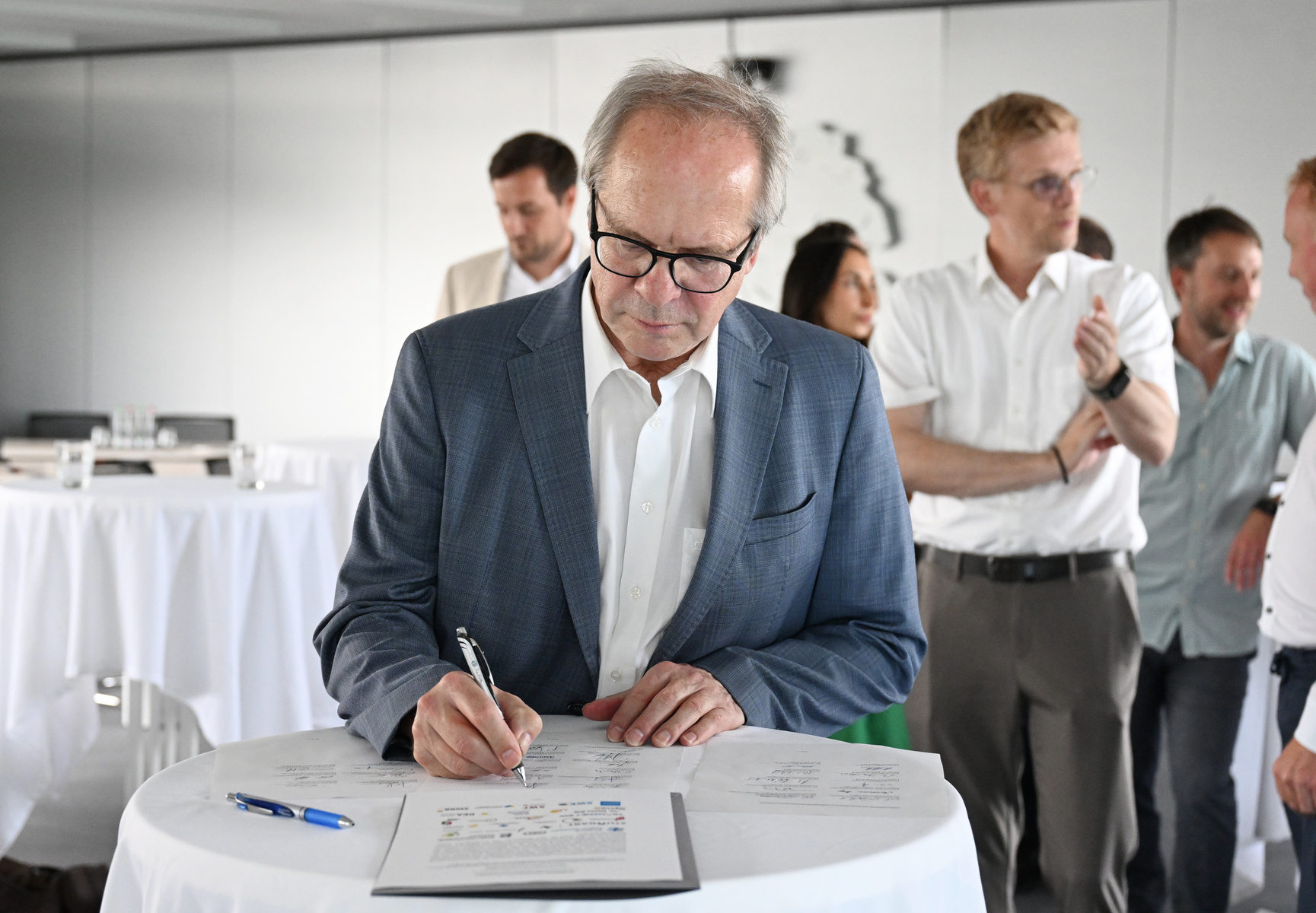




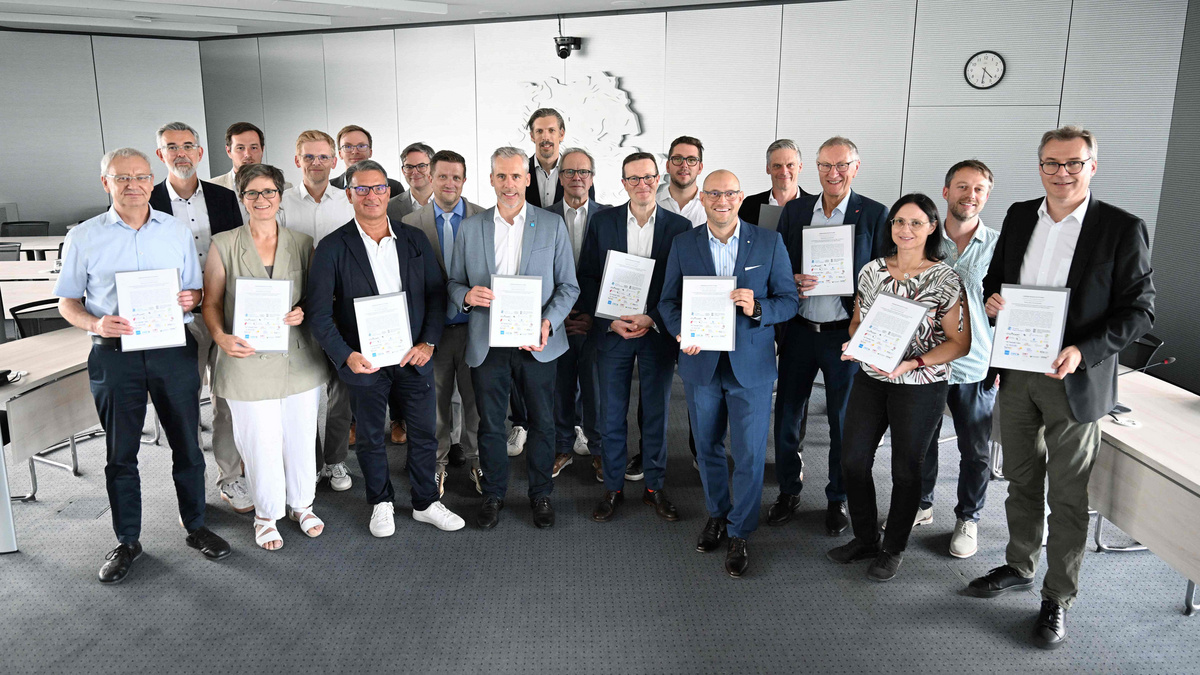
For a resilient and livable business hub like the Stuttgart region, the energy transition is essential: Industry requires enormous amounts of energy for local companies, businesses, and production. Climate targets must be met, and harmful CO2 emissions must be reduced. The 2.8 million people in the Stuttgart region also depend on a sustainable and affordable energy supply. Through a “Memorandum of Understanding,” the Stuttgart Region Association, together with partners from politics, grid operators, municipal utilities, and energy agencies, has committed in writing to taking action. This is a first step toward transparently and reliably coordinating and planning the future of energy supply in the Stuttgart region. Through joint strategies and task forces composed of experts, the expansion of renewable energy and the transformation of the energy system are to be achieved as a collaborative regional effort. The Energie.Region.Stuttgart initiative was developed jointly by the Stuttgart Region Association and the KEA Climate Protection and Energy Agency of Baden-Württemberg (KEA-BW).
These are the goals
- The focus is on upgrading the power grid infrastructure and the associated expansion of the power grid: Although the regional power grid is among the safest in the world, the demands placed on it have multiplied—for example, due to increasing electrification, high-consumption data centers, electric vehicle charging infrastructure, and so on.
- Land acquisition and securing of sites for grid infrastructure—such as substations and energy storage facilities—as well as areas designated in regional planning for wind and solar energy should be used efficiently
- Simplified and faster planning, permitting, and implementation processes
- Transparent communication of the transformation process and active public participation to foster societal acceptance
Across all these goals, the regional, cross-municipal approach plays a central role in ensuring the uniform implementation of measures on the ground in cities and municipalities.
“If we want to continue benefiting from a strong economy in the region in the future, we need the appropriate infrastructure,” says Dr. Alexander Lahl, Regional Director of the Stuttgart Region Association. “This also includes an electricity supply that is conceived holistically and that balances supply and demand in times of the energy transition and global crises. Together with our partners, we want to ensure that the necessary planning and approval processes proceed quickly. Only in this way can the region remain an attractive location, even when insulated from global shortages.”
“Our companies and local residents need a reliable and modern power grid. With the expansion of renewable energy, many different local facilities are feeding power into the grid. This boosts local economic value, but also places new demands on the distribution networks. Now we need to get our grid ready for the future—and quickly. That’s why I’m advocating for the acceleration of planning approval procedures,” says Susanne Bay, District President of the Stuttgart Administrative District, on the occasion of the signing.
“We are an economically strong and innovative region,” said Roland Bernhard, District Administrator of Böblingen. “As such, we depend on having sufficient capacity in our power grids, as this is a key location factor for districts and municipalities. New business settlements must not fail due to insufficient electricity capacity.” The transformation of the economy is in full swing, the District Administrator continued. “We are deliberately investing in digitalization, artificial intelligence, and startup support; the expansion of the power grid is an indispensable component of this.”
“With today’s signing of the Memorandum of Understanding, we are launching the Energie.Region.Stuttgart initiative and sending an important signal for the future,” said Esslingen District Administrator Marcel Musolf. “As the Esslingen District, we are actively on board and are doing our part to ensure that government agencies, grid operators, municipalities, and energy stakeholders jointly drive forward the upgrading and expansion of the power grid infrastructure, the provision of land, and accelerated permitting processes in the region. A swift and needs-based expansion of the power grids is a key challenge as electrification gains momentum in industry and commerce. Only with a high-performance grid infrastructure can the economic transformation in the region succeed.”
Strong Infrastructure, Strong Region
This initiative lays the foundation for attracting new businesses and retaining existing ones in the region. In this way, the economic structure is being realigned to be future-proof, while simultaneously securing jobs and creating new so-called “green jobs” in the energy sector. This ensures that the Stuttgart region remains a great place to live.
The signatories are: Dr . Alexander Lahl, Regional Director of the Stuttgart Region Association; Roland Bernhard, District Administrator of the Böblingen District; Marcel Musolf, District Administrator of the Esslingen District; as well as representatives of the Stuttgart Regional Council, the districts of Rems-Murr, Göppingen, and Ludwigsburg (represented by Chief State Official Jürgen Vogt), the state capital of Stuttgart, the Stuttgart Region Economic Development Corporation GmbH, the network operator Netze BW GmbH, Syna GmbH, and TransnetBW GmbH, the energy agencies of the Böblingen and Ludwigsburg districts, the Climate Protection Agency of the Esslingen District gGmbH, the Climate Protection Agency of the Göppingen District gGmbH, Stadtwerke Fellbach GmbH, Stadtwerke Böblingen GmbH & Co. KG, Stadtwerke Stuttgart GmbH, Stadtwerke Ludwigsburg-Kornwestheim GmbH, Stadtwerke Esslingen am Neckar GmbH & Co. KG, the District Climate Protection Agency gGmbH, the Stuttgart Energy Consulting Center e.V., and KEA Climate Protection and Energy Agency Baden-Württemberg GmbH.