



A New Home for the Integrated Control Center
There is an urgent need to build the Integrated Control Center: The control center is currently housed in the Ludwigsburg Fire Station. The existing facilities neither meet today’s requirements for a modern control center nor do they offer sufficient space. In addition, the City of Ludwigsburg has announced that it will need the currently leased space for its own use in the future. The control center must therefore vacate its current location.
This presents an opportunity to combine the necessary construction of the new control center with the disaster management center. Through this joint project, a modern and sustainable safety infrastructure will be created for the entire county.
Growing Need for Efficient and Modern Structures in Civil Protection
“The heavy rainfall events of recent years, widespread power outages, forest and wildfires, pandemics, and even the changing security situation in Europe show us very clearly: Crises are no longer merely theoretical scenarios. They are now part of our reality,” District Administrator Allgaier stated. Precisely for this reason, he added, structures in this area must be established today in a way that meets the demands of the coming decades.
Allgaier went on to say that the new disaster response center, affiliated with the ILS, is intended to serve as a central hub for civil protection in the district in the future. By consolidating key facilities, this will enable short communication channels, rapid decision-making, and close cooperation among the participating organizations in the event of a crisis—crucial factors for providing swift and effective assistance when the need arises. In addition, a permanently accessible operations center will be established to serve as the central point of contact for the public during a crisis. “In an emergency, these structures can play a decisive role in providing assistance more quickly and protecting human lives,” said District Administrator Allgaier.
Full Financing of Investment Costs Possible Through Grants
The total cost of the project is estimated at 34.9 million euros. The administration has thoroughly reviewed all relevant funding options. In addition to traditional fire department funding, the new State and Municipal Infrastructure Financing Act (LuKIFG) offers particularly great potential. After careful review, the district administration has concluded that the disaster response center, as municipal civil protection infrastructure, meets the requirements for funding under the LuKIFG. This opens up the possibility of financing the majority of the investment costs with federal funds. The remaining funds will come from fire department funding. This means the project can be built without any contribution from the district’s own funds. “We view financing from the special fund as a sensible and effective way to implement the project in a timely manner and to strengthen the district’s resilience to crises in the long term. Thanks to the LuKIFG, the district does not have to contribute a single euro of its own funds for the disaster control center,” said District Administrator Allgaier.
The building is designed for secure 24/7 operation
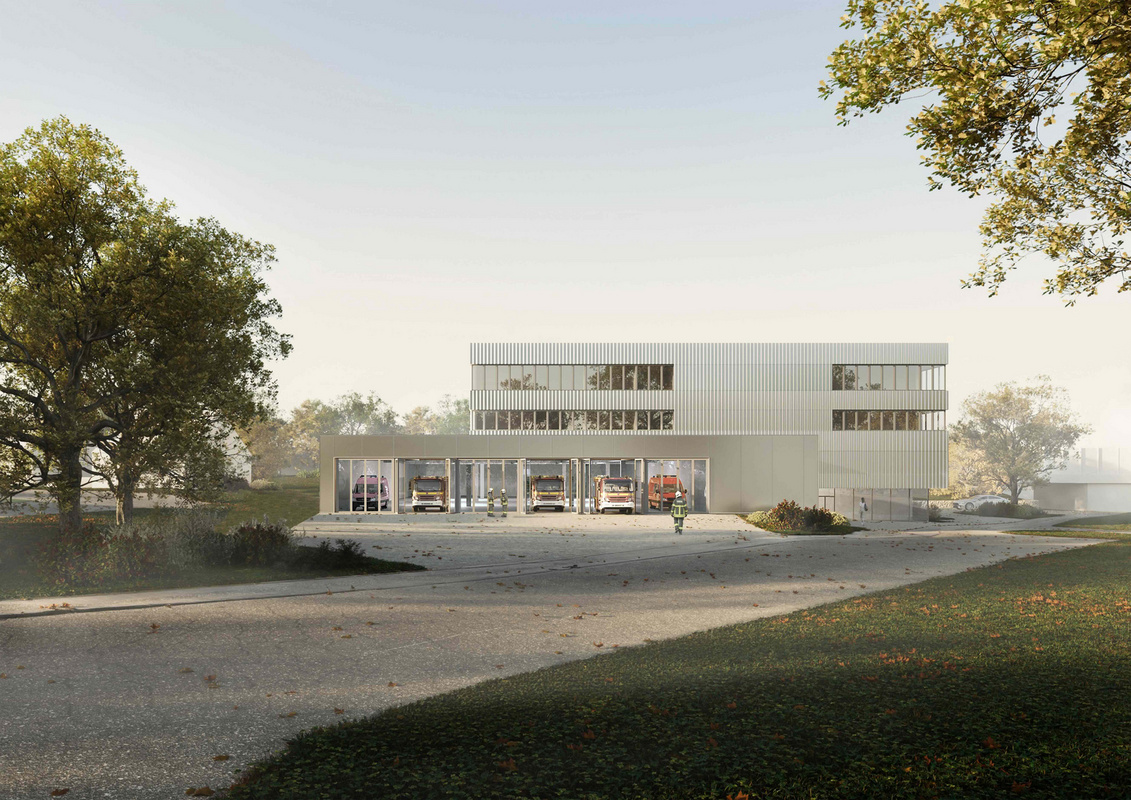
The completed design planning provides a solid foundation for the subsequent project phases as well as for cost and schedule planning. In the future, the new center will bring together the Integrated Control Center (ILS), disaster management, the command staff, the supply depot, and the vehicle garage at a single location. The close functional integration of these areas minimizes distances and enables fast and efficient operations during emergencies.
The building is designed for safe 24-hour operation seven days a week and meets the requirements for a high-performance civil protection infrastructure. At the same time, the design focuses on a sustainable and cost-effective construction concept: A hybrid construction method with a high proportion of wood, photovoltaic systems, a green roof, and resource-efficient materials contributes to climate protection. A compact design, a high degree of prefabrication, and durable materials also reduce construction time as well as operating and maintenance costs.
Acoustic assessments confirm the compatibility of future operations
Future developments have also already been taken into account. The modular building structure allows for flexible adaptations to changing requirements. Bright, barrier-free work areas and communication spaces create good working conditions for employees and emergency responders. Acoustic assessments also confirm that future operations will be compatible with the surrounding area. For parts of the adjacent residential area, the noise situation will actually improve as a result of the new building.