
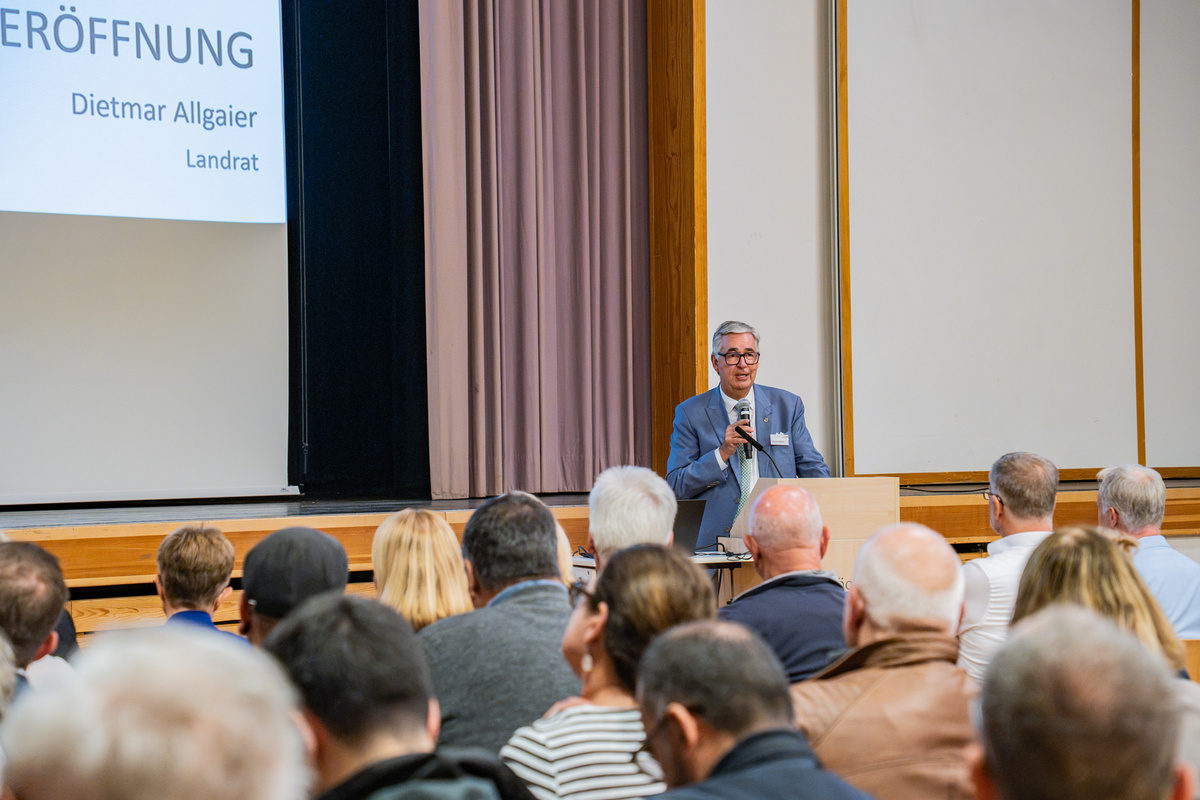
The Ludwigsburg District Light Rail Association hosted the elected officials’ forum. Participants included municipal council members from Ludwigsburg, Markgröningen, and Möglingen; members of the association’s board of directors; and district council members. Following welcoming remarks by Möglingen Mayor Rebecca Saile and Prof. Markus Schmidt from the Stuttgart University of Applied Sciences, District Administrator Dietmar Allgaier said in his opening address: “I very much welcome the state’s decision. It gives the municipal project sponsors the opportunity to continue planning with the announced support. This prioritization provides a solid foundation for making promising progress on the project.”
Transportation Minister Nicole Razavi announced last week that the state is classifying the reactivation of the Markgröningen Railway as a priority project. She announced that the state would provide half of the upfront funding for the planning costs. Subsequent co-financing of the implementation by the state is contingent upon federal funding under the Municipal Transportation Financing Act.
District Administrator Allgaier: “There have been differing resolutions in the individual municipalities and cities within the district. Our goal is to reach a consensus among the individual municipal councils by the end of March 2027.”
Technical presentations at the elected officials’ forum addressed the municipal resolutions, the options under consideration, and questions regarding funding, operating costs, cost allocation, and the timeline. The Deutsche Bahn operational program study that was presented received particular attention. According to the study, a 30-minute service interval with trains arriving at Ludwigsburg station is possible, provided the schedule is structured according to a specific pattern: trains arriving at the station at the 16- and 46-minute marks and departing six minutes later. Other time slots are not possible due to track occupancy. A 20- or 15-minute service frequency is not possible due to track occupancy, explained a representative of DB InfraGo. The company, a subsidiary of Deutsche Bahn AG, is responsible for the further development of the rail infrastructure.
In a moderated discussion, the elected officials addressed outstanding questions with the speakers and planners.
In closing, District Administrator Allgaier summarized: “The state’s decision is an important signal for the Markgröningen railway. We intend to tackle the next steps while respecting municipal decisions and in consultation with our partners.” Together with the members Remseck, Schwieberdingen, and the Pattonville Special-Purpose Association—which, following resolutions by the Ludwigsburg City Council, have each passed municipal and special-purpose association resolutions to withdraw from the planning process—discussions are underway that are scheduled to be concluded by the end of the first quarter of 2027.
The elected officials’ forum served as a platform for information and discussion. It does not replace municipal resolutions or formal decisions by the relevant bodies.