



This year, ten farms are once again participating in the project. Demand among farmers has now exceeded the available funding.
The goal is to enhance fields for field birds while continuing to use them for agriculture
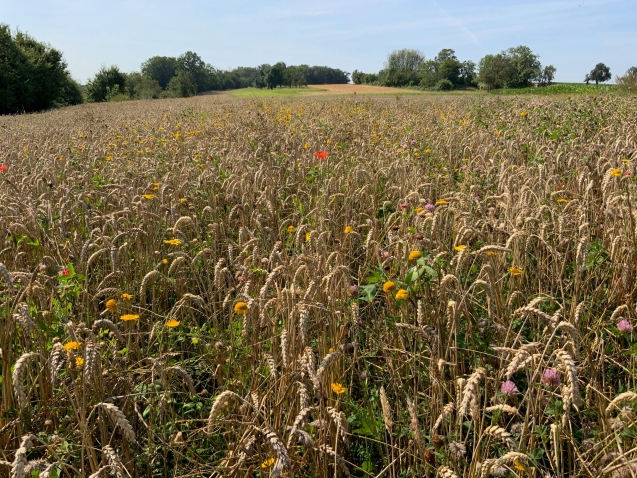
The focus is on so-called “open-row fields”—grain fields with wider row spacing, sometimes supplemented by flowering legume undersown crops. The goal is to ecologically enhance the fields for field birds without giving up agricultural use. The more open stands provide food, cover, and nesting structures for species such as the partridge and the skylark, while also supporting insects and wild field herbs.
The partridge is classified as critically endangered nationwide and is even threatened with extinction in Baden-Württemberg. Suitable habitats have become particularly rare in the intensively farmed agricultural landscapes around Stuttgart. In the “Schmidener Feld” near Fellbach and Remseck/Aldingen, targeted measures to protect field birds led to the first observed increase in partridge populations this spring.
Partridges prefer open fields with wide row spacing
“We need solutions that are both ecologically effective and agriculturally feasible,” explains Andreas Fallert, executive director of the Ludwigsburg District Landscape Conservation Association. “Many farmers are willing to try new approaches if the measures can be integrated into their farm operations and are economically viable.”
Supported by scientific studies conducted by the University of Hohenheim, the Institute for Agroecology and Biodiversity in Mannheim (IfAB), and other project partners, it has been demonstrated that partridges clearly prefer open fields with wide row spacing. At the same time, yields and market quality remain largely stable with adapted management practices.
Legume undersown crops significantly increase the food supply for insects
Open-row vineyards with flowering legume undersown crops are particularly promising. These significantly increase the food supply for insects and create additional habitats for field birds. Studies show significant increases in insect biomass and skylark broods.
“On the one hand, we’re supposed to produce high-quality food; on the other, we’re supposed to protect biodiversity, the climate, soil, and water—all while operating cost-effectively. That’s an enormous challenge,” says Florian Petschl, board member of the Heilbronn-Ludwigsburg District Farmers’ Association. This makes practical solutions that combine nature conservation and agriculture all the more important.
Farmers Create Valuable Habitats Through Special Cultivation Methods
The project in the Ludwigsburg district deliberately focuses on cooperation rather than simply setting land aside. Farmers specifically reduce pesticide use and fertilization, refrain from mechanical tillage during the breeding season, and, through these special farming practices, create valuable habitats right in the middle of the agricultural landscape.
The project is currently funded primarily by the Stuttgart Hofbräu Environmental Foundation. The foundation was established in April 1991 and endowed with 1 million DM. Since then, it has used the income from this endowment to support nature, landscape, and environmental conservation projects aimed at preserving the flora and fauna of Baden-Württemberg. The foundation has since funded more than 200 such projects with over 600,000 euros. Additional funding comes from the district and from LEV membership dues. Due to high demand, the project partners are hoping for additional support so that even more farms can participate in the future.
Both Agriculture and Biodiversity Can Benefit
“Experience shows that agriculture and biodiversity do not have to be at odds with one another,” says Fallert. “With expert advice, openness to new approaches, and fair compensation, both sides can benefit—agriculture as well as the endangered species in our cultural landscape.”