



Managing Director Andreas Fallert from the Landscape Conservation Association (LEV), his colleague Johanna Klebe and Alicia Läpple, biodiversity advisor from the Lower Agricultural Authority of the District Office, provided information on the occurrence of farmland birds and presented effective measures for their protection. Läpple reported that there has been a decline in many field bird species in recent years, such as the grey partridge and skylark. There are many reasons for this. In addition to structural change in agriculture, predators such as the fox also play a significant role. Due to traditional arable farming, the district with its open fields is of great importance for farmland birds throughout the country, explained Läpple.
Flowering fallow land is essential for a safe breeding site
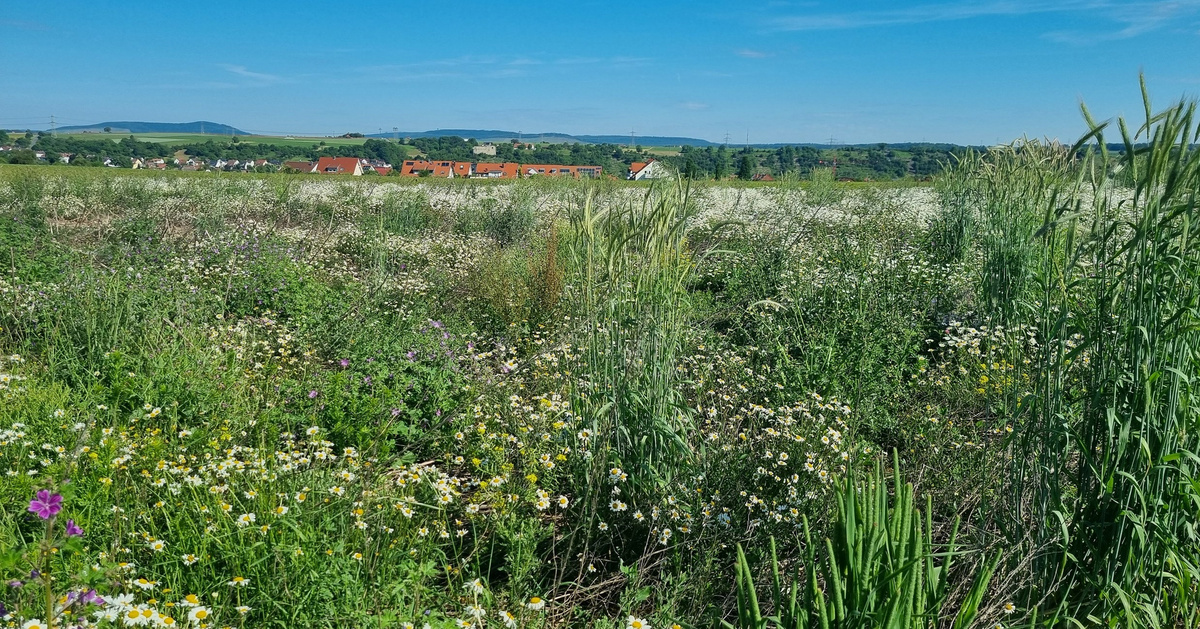
Johanna Klebe from the LEV presented the flowering fallow as an important measure. The creation of a wide-ranging and perennial flowering fallow is essential for a safe breeding site. Partridges and skylarks are ground breeders and therefore need sufficient cover, but also vegetation that is not too dense so that they can move around, explained the agricultural biologist. Perennial flowering fallows are particularly valuable. In the second year of cultivation, the number of insects increases there, which is important for the rearing of young birds, as they need animal protein in the first few weeks. When siting the flowering fallow, it is important to keep a distance from disturbances such as popular footpaths. Trees and tall bushes are also problematic, as birds of prey feel at home there and the parent and young birds become easy prey. During the breeding season for field birds from April to the end of August, farmers should not work the land to protect the animals, Klebe concluded.
The second effective measure presented by Klebe was the light tiller. Here, the grain is sown at a greater distance than usual. The loose vegetation allows the field birds to move around easily and safely. A flowering undersown crop is also ideal, providing cover and food, explained Fallert. The light tiller is a so-called "production-integrated measure". This means that the areas are used for agricultural purposes - albeit with lower yields - and are also valuable for nature conservation.
Funding programs presented
Läpple, Klebe and Fallert concluded by presenting the eligible funding programs. The funding is an expense allowance for farmers and thus provides financial compensation for the loss of yield, the purchase of specified seed and the adherence to timed work steps.
Farmer Mike Schiele then reported on his own experiences with a flowering fallow. "I've done the math, the support from the landscape conservation guideline is better in terms of the contribution margin with soil points of 30 to 40 than with winter wheat. But the subsequent costs due to the weed infestation of the area when it is included in the crop rotation again put this calculation into perspective," says the master farmer. The farmers were delighted with the insights and thanked the speakers with intensive discussions and professional exchanges.
Partridge protection also needs support outside of agriculture
Successful partridge protection also requires support outside of agriculture: Firstly, predators such as foxes must be reduced by hunters, as they hunt many partridges. Secondly, the danger from birds of prey can be reduced by regularly cutting back high hedges in sections. Dog owners can help by keeping their dogs on a lead, as partridges are very sensitive to disturbance. Fallert therefore appealed to dog owners to keep dogs on a lead, especially during the breeding season from April to August. Because if they are disturbed too often, partridges abandon their nests and even permanently abandon their young birds, which then have no chance of survival.
The conclusion of all those involved in the evening was that the combination of all measures can help to improve the living conditions and habitats for field birds in the agricultural landscape. Close cooperation between agriculture, nature conservation, hunters and the authorities is crucial here.
Information for farmers:
Farms with 10 ha or more of arable land must set aside 4% of their arable land. The LEV supports the sowing of flowering areas on these so-called "GLÖZ 8 fallow land" by distributing seeds free of charge.
Contact LEV: Andreas Fallert, Tel.: 07141 144-43165 or email: andreas.fallert[at]lev-ludwigsburg.de