




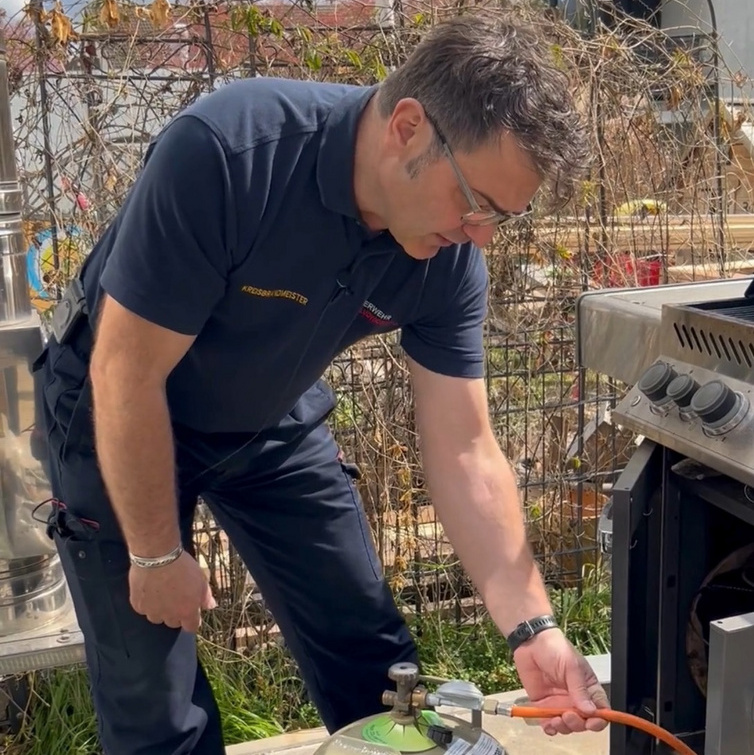
The location of the gas barbecue is crucial for safety. There must be no flammable materials in the vicinity. "Sufficient distance should also be kept from furniture and buildings," says district fire chief Andy Dorroch. This rule applies regardless of the type of barbecue - even with charcoal barbecues.
Barbecuing with gas: the right start
The barbecuing process begins with connecting the gas cylinder to the barbecue. Care is required here. "The cylinder should always be closed when it is not in use," explains district fire chief Andy Dorroch.
Before igniting the flame, a quick safety check is recommended: "I make sure that the hose is not broken, cracked or kinked." An integrated safety valve on the bottle provides additional safety. "This melts off if the gas cylinder gets too hot and blows off the gas without the gas in the cylinder heating up too much," says Dorroch.
Once the barbecue fun is over, the barbecue must be safely switched off. First, the gas supply to the barbecue itself is stopped, then the gas tap on the cylinder is turned off. This is the only way to ensure that no gas escapes uncontrollably.
In an emergency: call the fire department
Especially when grilling with greasy food, it can happen that fat drips into the flames and ignites. Dorroch advises to stay calm: "If the fat falls from the food and ignites, don't get nervous." His tip: "Close the grill lid and turn off the gas supply." As soon as the gas stops flowing, the flame usually goes out by itself.
If the fire gets out of control or there is uncertainty, help is needed quickly. "Anyone who is unsure and cannot estimate the extent of the fire should call 112," advises Dorroch and emphasizes: "It's better to call the fire department. That's what we're here for - and we're happy to do it."