



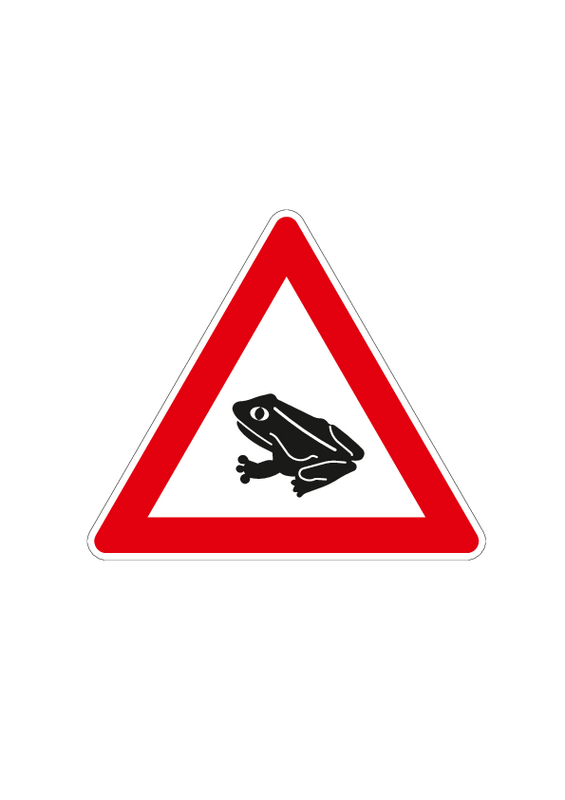
A warning sign with a frog is a clear indication that the animals are migrating. They have a much better chance of survival if all road users drive at an appropriate speed - provided they are not run over directly. At a speed of more than 30 kilometers per hour, an extreme suction effect occurs, which often leads to severe internal injuries in the animals and thus to avoidable death. Drivers are therefore asked to show understanding and consideration during the affected period. Cyclists should also be careful, especially at dusk and at night, and show consideration for the animals.
Nationally significant fire salamander population in the Strudelbach valley
In addition to toads and frogs, many fire salamanders are also on the move in the district. In the Strudelbach valley near Eberdingen, for example, there is a nationally significant fire salamander population. For this reason, it is necessary to close the district road 1688 in this area in particular. Special fire salamander signs are in place to indicate these migration sites.
The ordered speed restrictions apply from the early evening until the early hours of the next day. In order to enforce the limits, the district office's radar measurement vehicles will once again be deployed primarily where there are traffic restrictions to protect the amphibians and helpers. In this context, the district office would like to point out that other traffic violations, such as ignoring road closures, will also be punished.
To protect the amphibians, there are full road closures in the evening and at night
The migration period of amphibians varies from species to species and lasts until the end of April or beginning of May, depending on the weather, and until the end of May in the case of the rare fire salamander. Most closures and other measures therefore apply from now until the end of April - and initially until June 1 where fire salamanders are present. As the end of the fire salamander migration depends on the weather, the end of the closures can be brought forward or extended.
In order to protect the amphibians, the following municipalities and towns are closing the amphibian migration sites to traffic in the evening and at night:
- Affalterbach: Theaccess road Lemberg coming from the Lemberghalle, junction Lembergweg - Feldweg in the direction of 7 Eichen.
- Besigheim: Field path in the area of the "Pfander'schen Baggerseen/Neckartalsee" and "Einet" area.
- Bönnigheim/Kirchheim: Municipal road between Hofen and Hohenstein and between Hofen and Kirchheim. Schützenhaus area. Kirchheimer Weg area.
- Eberdingen: Connecting road Hochdorf - Enzweihingen (Enzweihinger Str.) at the level of the Weniger nursery. Cycle path between the built-up sections of Eberdingen and Vaihingen-Riet. K1688 between Eberdingen and Weissach.
- Erdmannhausen: Closure of Kirchberger Straße from the end of the village (field path) to the junction of Kreuzweg.
- Markgröningen: Talhausen connecting road. Bergweg and Schlüsselbergweg. Junction with field path at the old quarry (Knollenberg-Obere Mühle). Hummelberg area, Ried, fish ponds.
- Möglingen: Field paths in the "Im Bornrain" area and adventure playground.
- Mundelsheim: Seebachweg. Hiking parking lot "Vogeltränke".
- Pleidelsheim: Field path in the Riedbachaue area after the "Murrer Weg" junction during the evening and night hours and all day at weekends.
- Walheim: Baumbachtal country lane between the Wolfssteinklinge section and the Bönnigheim-Hofen boundary. Country lane in the Baumbach valley from the Baumbach bridge to the existing closure between the Wolfssteinklinge section and the Bönnigheim-Hofen boundary.
Speed restrictions, warning signs and other traffic control measures to protect amphibians are also in place in the districts of Benningen, Ditzingen, Großbottwar, Hemmingen, Kleiningersheim, Hessigheim, Sachsenheim, Schwieberdingen, Steinheim and Vaihingen an der Enz.
Large district towns and local traffic authorities can also issue orders
The large district towns and local traffic authorities can issue traffic regulations on their own authority - this year, Ludwigsburg, Bietigheim-Bissingen and Freiberg am Neckar are doing so.
The following roads will be fully closed in the evening and at night:
In Ludwigsburg, Fröbelstraße (west of the Waldorfschule junction and west of the FH parking lot access road), at the start of Hartstraße, in Ludwigsburg-Hoheneck, Bengertsweg and Ölmühle (in Bangertsweg below the vineyards) and in the area of the Neckar cycle path after the sewage treatment plant in the direction of Marbach as well as areas of Königsallee, the end of Poppenweiler (at the end of the "Sommerhalde" road on the west side from the barrier in a south-easterly direction).
In Bietigheim-Bissingen, Schleifmühlenweg has been closed to vehicles all year round with a bollard since February 2022 to protect the salamanders. Theaccess road to the chopping area at Rotenacker Wald is only closed at night (and in appropriate weather conditions).
In Freiberg, the speed limit in Austraße will be reduced to 10 km/h.
In Gerlingen: Krummbachtalstraße.
In Korntal-Münchingen: east of the Grüner Heiner.
Amphibian migration routes and occurrences not yet known can be reported to the lower nature conservation authority of the Ludwigsburg district office by calling 07141 144-42158 or sending an e-mail to: umwelt[at]landkreis-ludwigsburg.de.