



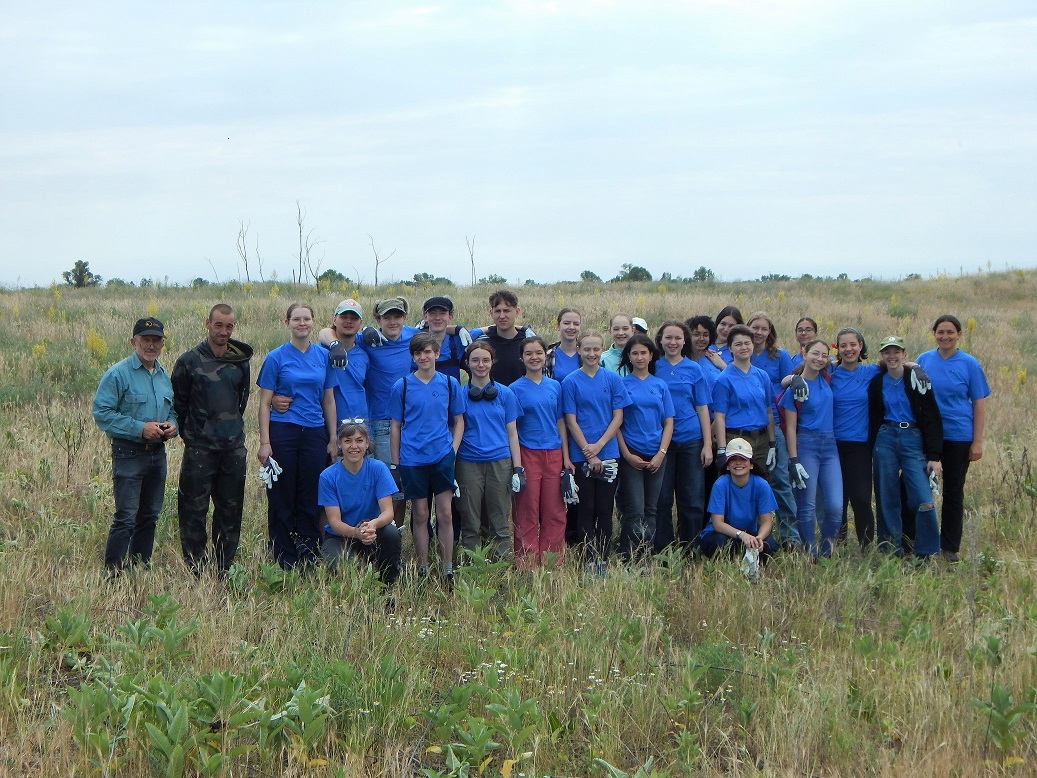
This year's youth exchange was attended by 19 pupils - 14 girls and five boys - from the district of Ludwigsburg as well as additional Hungarian young people, some of whom had already visited the district of Ludwigsburg last year.
The group was accompanied by Dr. Rolf Gastel, who helped set up the Tápió project from the very beginning and is involved in the Tápió Foundation, as well as Susanne Blank and Lara Wiechert from the Environment Department of the District Office.
Contributing to the preservation of the rare sand dune and loess flora with practical work
The very varied programme organized by Piroska Wenhardt (Chairwoman of the Tápió Foundation) and Janos Vince (Managing Director of the Tápió Foundation) included a visit to the Tápió Foundation's nature conservation center in Farmos, excursions to the large and very species-rich nature reserves with extensive wetlands, salt marshes and inland sand dunes with their very special fauna and flora. Great egrets and purple herons, as well as tropically colored bee-eaters and rare Eurasian Roller could be observed with telescopes, as well as lapwings and corn buntings, which have become extinct in the Ludwigsburg district in the last two decades.
Practical nature conservation and landscape management work contributed to the preservation of the rare sand dune and loess flora between the Danube and Tisza rivers. Among other things, wild waste deposits, which are still a major problem locally, were removed from the 50-hectare Erdöszölö sand dune area near Nagykáta - the largest municipality in the Tápió region - which belongs to the Tápió Foundation. Invasive plant species that endanger the native flora were also removed there. In Tápióbicske, overgrown loess walls in a former clay pit were restored as an important breeding area for bee-eaters and the wooden staircase with viewing tower, tables and benches set up to guide visitors was renovated.
Highlights included the ringing of young white storks and small birds by national park ranger and former camp participant Gergö Sari, as well as the accompanying program with presentations of traditional handicrafts and regional music and dance performances.
Environmental and nature conservation foundation of Kreissparkasse Ludwigsburg provides financial support
The very interested and committed young Germans aged between 14 and 20 were also particularly impressed by the vast landscape, which is sparsely populated compared to the Ludwigsburg district, and by the extremely warm hospitality of their Hungarian hosts.
The youth nature conservation camps have been financially supported for many years by the Environmental and Nature Conservation Foundation of Kreissparkasse Ludwigsburg.
The Tápió area, which covers around 720 square kilometers, has a particularly large variety of habitats typical of the Hungarian lowlands, such as still waters, reed beds, wet meadows, salt marshes and sand dunes as well as the loess hills. To protect the particularly valuable flora and fauna, including the imperial eagle, white stork, European Roller, otter and pond turtle, as well as numerous plant species such as the meadow iris, feather grass and late carnation, ten nature reserves with a total area of 4,500 hectares have been designated, which are directly under the control of the National Park Directorate and are also part of the European NATURA 2000 network of protected areas.
Tápió Foundation and youth encounters an important component of partnership relations
The Tápió Foundation, in which Pest County, the Tápió municipalities, the Hungarian Society for Nature Conservation and Ornithology (MME) and the district of Ludwigsburg are jointly involved, was established 28 years ago to promote the sustainable development of the Tápió area as a model ecological region. In addition, a new nature park initiated by the Tápió Foundation was established there in 2019.
The Tápió Foundation and the encounters between young people from the two partner counties have become one of the most important building blocks of the partnership.