



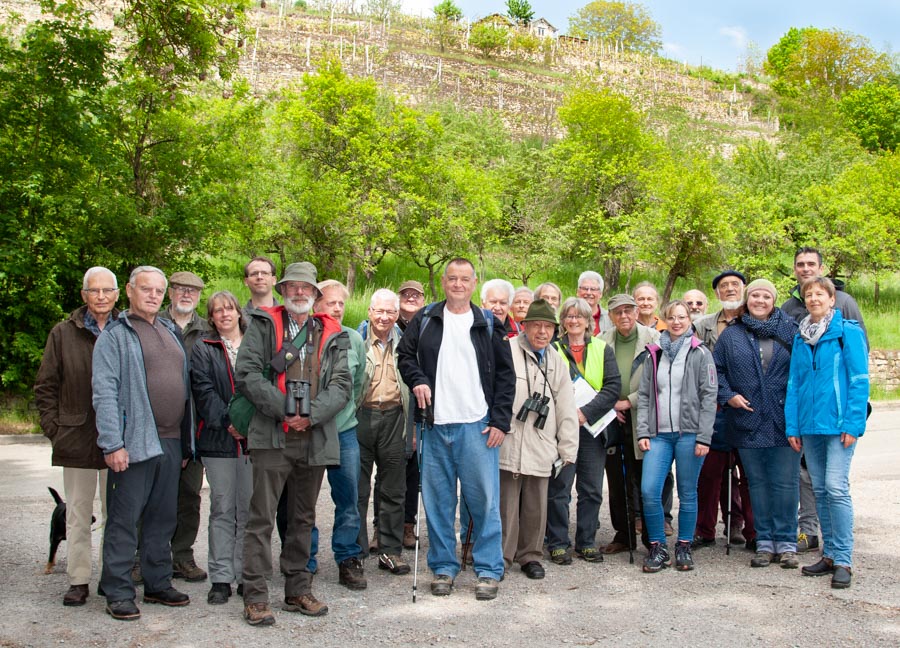
After the welcome and appreciation of the volunteers' work by Dr. Christian Sußner, the responsible department head of the district office, the almost three-hour nature excursion of the volunteer nature conservation wardens led along the Glems from the Glemstal stadium to Markgröningen-Talhausen behind the sewage treatment plant.
The volunteers were guided by Dr. Franz-Josef Obergföll, nature conservation specialist at the lower nature conservation authority of the district office, and accompanied by Petra Klose, nature conservation and landscape management specialist for the town of Markgröningen. Practical explanations were provided by members of the local nature conservation association (NABU), who are active in amphibian conservation. NABU Markgröningen has been working with other citizens for decades to protect amphibian migration in the Glemstal valley. Many practical questions and problems were discussed during the excursion.
Petra Klose began by explaining the measures that are taken on site every year to protect the migrating amphibians, such as the standing half-barrier from the direction of Markgröningen after the junction from Vaihinger Straße onto the road to Talhausen. NABU Markgröningen board member Helmut Schäfer and Johannes Meiwes reported on the members' efforts to save as many animals as possible from roadkill. Every animal that crosses the local road to Talhausen alive is important to the volunteers. The active members of the association get up early in the morning to help the fire salamanders that keep wandering along the kerbs to cross the road. Particularly important in the Glemstal are the pregnant female salamanders, which like to lay their already living offspring in small streams, but also in puddles on the road.
During the excursion, there were explanations about fire salamanders, common toads, yellow-bellied toads, green toads, Alpine newts and pond newts. The nature conservation wardens were also interested in other natural sights in the Glemstal, such as the dry stone walls, orchids and the herd of Edmund Wörner, the town shepherd. A particular highlight was the foil ponds behind the Talhausen sewage treatment plant. At the beginning of the forest, a number of small artificial frog ponds were constructed, which are looked after by the local nature conservation association. A close look into the ponds revealed amphibian and dragonfly larvae. Not only the rare yellow-bellied toads, but also some alpine newts and baby fire salamanders were visible. The direct encounter with these animals was a special moment for some nature conservation wardens and for a few children who were at the ponds.