




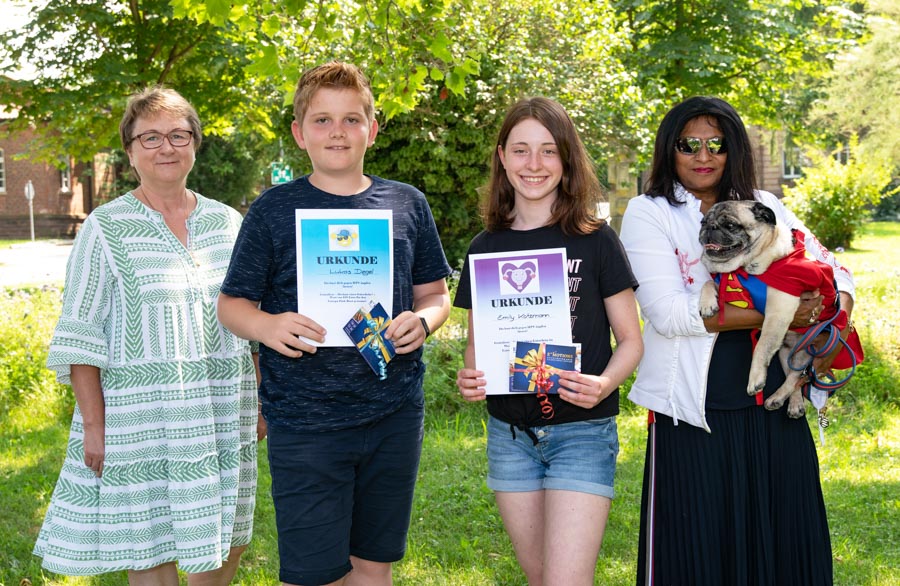
With the focus on coronavirus vaccinations, other vaccinations that protect against very serious diseases must not be forgotten. The award ceremony for the 2020 campaign by the district health department for vaccination against human papillomavirus (HPV) could only take place recently due to vaccine supply bottlenecks.
Dr. Uschi Traub, Head of Health Promotion, and Gela Ertmann, together with mascot Superdog Pablo, presented the prizes to the winners of the raffle as part of the campaign. Emily Kotzmann (Stromberg-Gymnasium, Vaihingen an der Enz) and Lukas Dengel (at the beginning of the campaign at Hans-Grüninger-Gymnasium, Markgröningen and now at Helene-Lange-Gymnasium, Markgröningen) were delighted with their prize: vouchers worth 110 euros for Europapark Rust.
During the campaign under the motto "HPV - Don't let the virus win!" at all secondary schools and in surgeries in the second quarter of 2020, the Ludwigsburg health department and the medical profession, with the support of the school principals, informed all pupils in year 6 and their parents. The campaign has been held annually since 2018.
Sandra Dengel, mother of twelve-year-old Lukas, is happy: "The injection was worth it for Lukas, even though he is afraid of injections." Andreas Kotzmann, father of thirteen-year-old Emily, thinks the HPV vaccination is important for boys and girls so that "they stay healthy themselves and don't infect others". Lukas and Emily have been vaccinated so that they "don't get the HPV-related diseases". They also want to motivate their classmates to get vaccinated after consulting their parents. All sixth-graders who had been vaccinated against HPV at least once by June 30, 2021 were able to voluntarily take part in a prize draw. All they had to do was send a certificate stamped by their pediatrician or family doctor to the public health department.
The number of HPV vaccinations billed to the Baden-Württemberg Association of Statutory Health Insurance Physicians in the 3rd quarter of 2020 in the district of Ludwigsburg (1691) remained significantly higher than in the comparative district of Esslingen (1432), despite vaccine shortages.
The vaccination rate against human papillomavirus in Germany is not sufficient for comprehensive protection. This is achieved with a vaccination rate of at least 70 percent. According to the German Cancer Research Center, vaccination rates are particularly low in southern Germany. While good rates of around 60 percent are achieved in the new federal states for 15-year-old girls, this figure is only around 35 percent in Bavaria and Baden-Württemberg. By comparison, the Scandinavian countries and Australia report vaccination rates of 80 to 90 percent.
"We must not forget that at least six types of cancer are attributable to HPV," emphasizes Uschi Traub. Cervical, vulvar, vaginal, mouth and throat, anal and penile cancers are diagnosed in around 1,700 men and 6,000 women every year.
Info:
The HPV vaccination protects nine out of ten women against cervical cancer, eight out of ten against vaginal cancer and seven out of ten against vulvar cancer. Nine out of ten vaccinated men and women are protected against anal cancer and six out of ten against mouth and throat cancer. Furthermore, the vaccination prevents the occurrence of penile cancer in six out of ten cases. The Gardasil 9 vaccine offers additional protection against HPV types, which are responsible for around 90 percent of genital warts.
More than 270 million doses have been administered worldwide since the vaccine was approved. Both before and after approval, the safety of the HPV vaccination was examined in various extensive studies. According to the Robert Koch Institute, no serious side effects causally related to the HPV vaccination were identified. In particular, the studies showed no connection with autoimmune diseases or neurological complications.
or neurological complications. Side effects such as headaches, dizziness or fatigue are common and can also occur in a severe form. However, these are temporary and completely reversible. As with other vaccinations, anaphylaxis can occur in very rare cases (approx. 1.7 cases per 1 million vaccinations).
If you have any questions, please contact Dr. Uschi Traub, tel. 07141 144-2520, email: gesundheitsfoerderung@landkreis-ludwigsburg.de.