



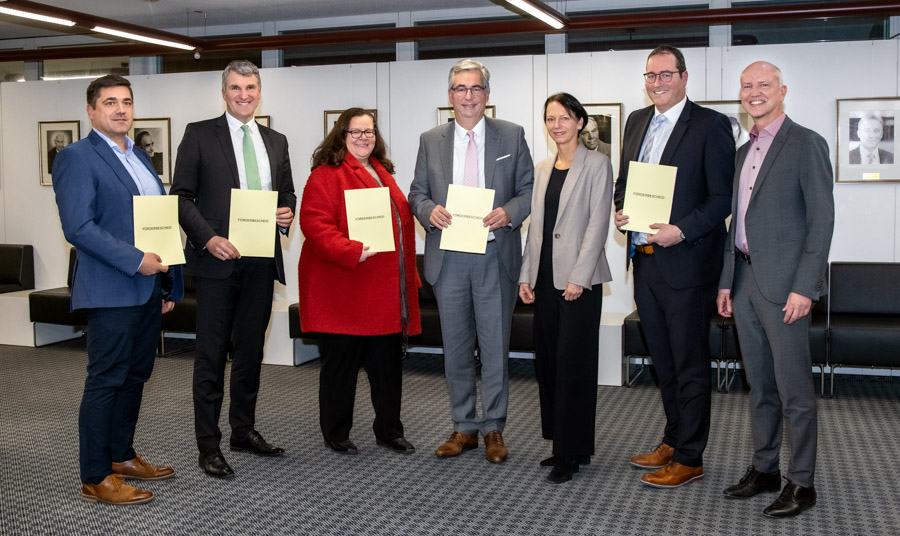
"I am delighted to personally hand over these funding decisions today and thus support the development and modernization of the schools," said District President Susanne Bay today at the handover in the Ludwigsburg District Office. At the same time, she emphasized: "Such projects are financial and planning feats of strength. But they are worth it, because they are investments in our children and young people and therefore in our future."
The town of Besigheim is receiving around 2.5 million euros from regular school construction funding for the expansion of its community school and a further 1.56 million euros from the special program for accelerated all-day expansion.
Freiberg is rebuilding its school center, consisting of a secondary school, community school and grammar school, and will receive a further 10.15 million euros from the regular school construction funding this year. In total, the town has therefore received around 21.8 million euros for the new school center.
The city of Ludwigsburg will receive 3.2 million euros for the Fuchshof School from the regular school construction funding and around 4.2 million euros for ten other elementary school from the aforementioned special program.
Remseck will receive around 1.7 million euros for the Wilhelm-Keil-Gemeinschaftsschule from the regular school construction funding. The town had already received around 2.2 million euros from the special program last year.
The district, with its many school buildings, is being supported this year with 2.96 million euros for the expansion of the Erich Bracher vocational school in Pattonville. "I am delighted about the large amount that the state is making available for school buildings in the Ludwigsburg district, especially for the expansion of our Erich Bracher School - thank you very much for that," said District Administrator Dietmar Allgaier at the event.
These school building projects illustrate the particular challenges faced by local school authorities when planning schools. Besigheim, for example, had to plan the expansion of its school in a very small construction window in the middle of the old town hill and its listed buildings and areas due to the local conditions. In Remseck, the plans were revised several times before the concept met the structural and educational requirements and financing could be guaranteed alongside the design of the new town center. In the case of the town of Freiberg, the new school center is even a central element in the redesign of the town center.
Due to building law requirements, all school buildings must be built using sustainable construction methods. The new Fuchshof elementary school in Ludwigsburg is a successful example of this, which is easily revealed to the visitor. Only the central structural elements are cast in recycled concrete, while the rest of the school building was constructed using timber. For rural districts with their large vocational school centers, the changing needs of industry and production methods are also a key requirement when planning school buildings for upcoming renovations and extensions.
Background information:
In 2022, the state is funding a total of 73 municipal school construction projects in the administrative district of Stuttgart with grants of around 78 million euros. Of these, eight school construction projects in the Ludwigsburg district received around 20.9 million euros. A further almost 11 million euros flowed into the Ludwigsburg district from the special program for accelerated all-day expansion at elementary school.
The state's school construction funding programs (conventional school building construction, all-day construction funding, private schools and school renovations) are approved and monitored by the regional councils. The Stuttgart Regional Council has the task of advising the towns and municipalities in the administrative district on funding law issues and assessing the funding applications. It is also the approval body and checks the local authorities' accounts after completion of the measures.