



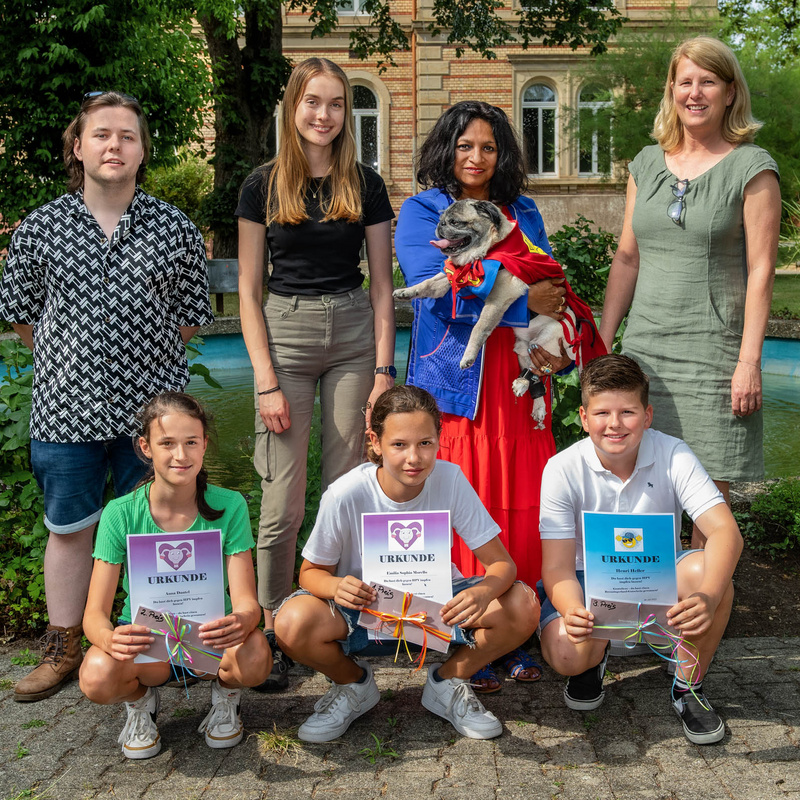
The Breuninger vouchers were presented by the campaign's "superdog", Pablo the pug, together with Dr. Uschi Traub, Head of Health Promotion at the District Office. The finalists took part in a game of skittles, a game of whiz puck and a game of cross-boules. The respective winners answered questions on the topic of HPV such as "From what age does the STIKO (Standing Committee on Vaccination) recommend HPV vaccinations?" (correct answer: from the age of nine) or "How many HPV vaccinations do you need?" (correct answer: two to three, depending on age).
During the campaign under the motto "HPV - Don't let the virus win!" in surgeries and at all secondary schools in the first quarter of 2023, the Ludwigsburg health department and the medical profession, with the support of school principals, informed all pupils in year 6 and their parents. The campaign took place for the sixth time.
The winners agreed that they get vaccinated so that they "get less cancer", and their parents want to protect their children from cancer and "trust the experts from the Standing Committee on Vaccination". Parents and young people also attach great importance to the advice they receive from their pediatricians and gynecologists, which is often a decisive factor in the vaccination decision.
Uschi Traub emphasizes: "Men and women are affected - unsightly, annoying genital warts and at least six types of cancer can be traced back to HPV: Cervical, vulvar, vaginal, mouth and throat, anal and penile cancers." One health promotion employee, Ute Nethe, remembers her daughter taking part in the very first campaign: "I am glad that this vaccination was made available and that my daughter now has this protection," says Nethe.
An employee from the Villingen-Schwenningen health department attended the event to look into the possibility of adopting the project in their own district.
Info:
HPV is the most common sexually transmitted infection. 80% of all people become infected with HPV in the course of their lives. In Germany, 6250 women and 1600 men develop HPV-related cancers (cervix, vulva, vagina, penis, anus, mouth and throat) every year. The HPV vaccination protects against 90% of all cervical cancers, 90% of anal cancers, 60% of penile cancers, 60% of oral and pharyngeal cancers and 90% of genital warts. In 2021, the HPV vaccination rate for the full vaccination series was 54% for 15-year-old girls and 27% for 15-year-old boys. The WHO and the EU Commission have set themselves the goal of fully vaccinating ≥ 90% of 15-year-old girls by 2030 and achieving a significant increase in the HPV vaccination rate for 15-year-old boys. Some countries, such as Portugal, have already achieved this vaccination rate. Germany is only in 37th place out of 46 high-income countries.