

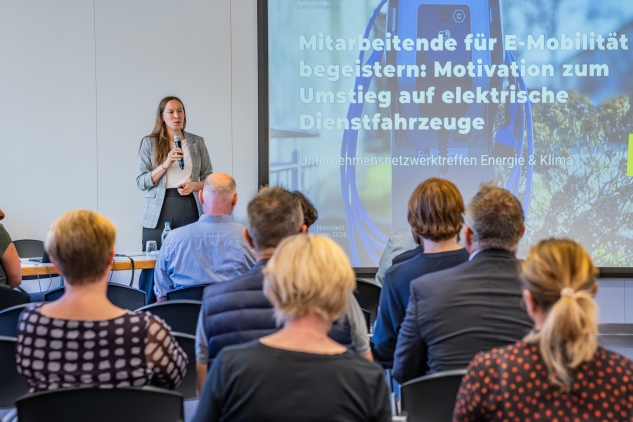
How can a vehicle fleet be successfully and cost-effectively converted to electric mobility? How can employees be encouraged to use electric company vehicles? And what support is available for companies in the region? These were the questions addressed by the participants at the most recent meeting of the Energy & Climate Business Network.
To kick things off, Martin Kurt, Head of the Department of Urban Planning, Mobility, and Geoinformation for the City of Ludwigsburg, welcomed the approximately 40 participants and expressed his delight at the high level of interest in the event.
Electric Mobility in the Fleet: More Than Just Replacing Vehicles
In his presentation titled “Electric Mobility in the Fleet: Established Paths to Transformation and New Opportunities,” Manfred Schmid, Managing Director of Institut Stadt-Mobilität-Energie GmbH, outlined what companies should consider during the transition.
First and foremost, he emphasized the importance of having a thorough understanding of one’s own fleet and its actual usage. If usage patterns and charging infrastructure align, he noted, the electrification of a fleet can be achieved without incurring additional costs. In addition, the combination of photovoltaic systems, energy storage, and smart load management offers opportunities to specifically control charging capacities and charging times and to make the transition cost-effective.
“Electric mobility in a fleet is no longer just about replacing vehicles. When planned correctly, it becomes a controllable part of the company’s energy system—offering opportunities in terms of costs, grid connection, and renewable energy,” said Schmid.
Employees as the Key to a Successful Transition
Judith Nienstedt, project manager for municipalities at the Ludwigsburg District Energy Agency (LEA e.V.), made it clear that a successful transition does not depend solely on technology. In her presentation, “Getting Employees Excited About E-Mobility: Motivation to Switch to Electric Company Vehicles,” she put the focus on employees.
Only when employees embrace the change positively and are willing to alter their mobility habits can technical innovations fully realize their economic and environmental benefits. Companies should therefore prioritize effective communication from the start, answer questions, and involve their employees in the change process.
Nienstedt noted: “The switch to electric company vehicles is not just a technical change, but also a matter of acceptance. That’s why the focus is on alleviating employees’ reservations.”
Corporate Mobility Is Becoming a Location Factor
Alexandra Bading, Theme Manager for Sustainable Mobility / Corporate Mobility Management at the Stuttgart Region Economic Development Corporation, explained what support companies in the region can receive. In her presentation on offerings in the region, she highlighted why good and sustainable mobility is increasingly becoming an important location factor for companies as well.
The Stuttgart Region Economic Development Agency supports companies—among other things through the Regional Initiative Program for Corporate Mobility Management—in developing suitable solutions for their corporate mobility needs.
“Corporate Mobility Management combines three key objectives: employer attractiveness, cost-effectiveness, and climate protection. As a regional economic development agency, we support companies and institutions with practical advice, our BMM Initiative Program, regional networking events, and a website full of information and best-practice examples,” said Bading.
Many Questions from Business Practice
During the discussion that followed, participants were able to share their own experiences, discuss specific questions, and network with other companies.
The high level of interest was also evident in the numerous follow-up questions. Companies were particularly concerned with how quickly plans for an electrified fleet can be put into practice, how to convince employees to switch to electric mobility, and how to make the transition economically viable. The possibilities for financial support were also of interest to many companies.
Energy & Climate Business Network
The Energy & Climate Business Network is the new network for businesses in the Ludwigsburg district. It has replaced the previous Ludwigsburg Climate Alliance Business Network, which was operated by the City of Ludwigsburg.
Next Network Meeting at Huober Brezel
The next meeting will take place on November 26, 2026. The host is Huober Brezel. The family-owned business will provide insights into its operations and its use of the EMAS (Eco-Management and Audit Scheme) environmental management certification. In addition, participants will receive background information on EMAS environmental management and current requirements for businesses.
Companies from the Ludwigsburg district can sign up now at www.ludwigsburg.de/klimaschutz+in+unternehmen to join the mailing list and receive updates on upcoming events.