




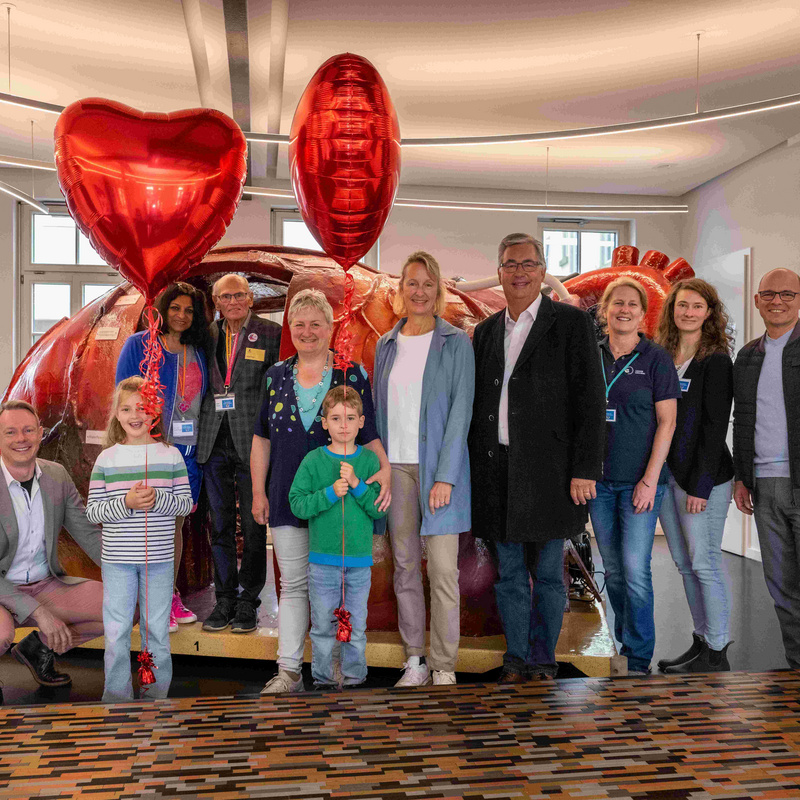
On June 1, discussions were held with interested parties in front of and in Markt 8 on the market square in Ludwigsburg. Information material, organ donor cards, a competition with prizes (such as syringe pens, anti-stress hearts, power banks, etc.) and blood pressure measurements were used to provide information. Citizens were able to view transplantable organs on a torso model. A doctor guided visitors through a walk-in heart and demonstrated common diseases affecting this vital organ.
For Mayor Sebastian Mannl, it is a matter close to his heart: "Organ donation is a difficult topic for many people, often associated with uncertainty. We should take every opportunity to provide information about this important, life-saving topic and talk to people about it," he emphasizes.
"Every organ donor is a lifesaver," adds Dr. Uschi Traub, Head of Health Promotion at the Health Department, "without giving, there is no taking." Each of the 965 people who donated an organ in Germany last year gave an average of three seriously ill patients the chance of a longer and better life after their death. One donor can save up to seven people. Nevertheless, almost 8,400 people are currently waiting for a transplant, with almost 1,000 patients in Baden-Württemberg alone.
Organ Donation Day aims to raise awareness: "Organ donation is a great gift"
For transplant recipients, the day is also a day of thanks. "An organ donation is a great gift and gives many years of life," says Josef Theiss from the German Liver Transplant Patients' Association. The liver he received as a gift saved his life 30 years ago. Theiss is eternally grateful to his donor, who made it possible for him to celebrate his 54th plus30th birthday this year. He is celebrating his 84th birthday this year.
Alexander Thum, Head of the Prevention Division at AOK, was also involved in the campaign on Ludwigsburg's market square: "We support our policyholders and send
them detailed information and an organ donor card when they reach the age of 16. Anyone who has specific questions can get free advice from medical experts at any time by calling 0800 1 265 265."
Organ donor card, living will or online register - a wide range of options
All those involved in the Ludwigsburg campaign are in favor of the opt-out solution, including Baden-Württemberg's Minister of Social Affairs Manne Lucha. Under this regulation, everyone is considered an organ donor if they have not actively objected. Germany is one of the few countries in Europe without an objection solution, while organs from other countries with this solution are gratefully accepted.
All too often, organ donations fail due to a lack of consent. This applies in particular to cases in which relatives have to make a decision without knowing the wishes of their deceased loved one. In 2023, this was once again one of the main reasons why potential organ donors did not donate - despite the fact that, according to surveys by the Federal Center for Health Education, eight out of ten respondents were in favor of organ donation.
"Everyone should inform themselves, make their own decision for or against organ donation, document it in the organ donor card, in the living will or in the online register and inform their relatives. Relatives are under an enormous burden when they have to decide according to the presumed will of the deceased," says Dr. Karlin Stark, Head of the District Office's Health and Consumer Protection Department.
Organ donation can affect anyone
Organ donation is an issue that can affect anyone. After all, the risk of needing a life-saving organ is three times higher than the chance of being an organ donor, as this is only possible in the event of "brain death".
Since March 2024, the organ donation register has offered a new digital option for legally binding documentation of the decision. Registration is voluntary and free of charge. In contrast to the organ donor card, which can be lost or cannot be found, for example, the organ donor register is always available. The register data cannot be viewed by the public and is protected from access by unauthorized third parties. Any person wishing to make, amend or revoke a declaration in the organ donation register must first authenticate themselves using secure procedures. Access to the declaration by authorized hospital staff is also only possible after prior registration and authentication.
FAQs on organ donation
Will my declaration on organ and tissue donation in my living will or in my organ donor card remain valid despite the register?
Yes, you can continue to record declarations on organ and tissue donation in an organ donor card or in a living will. Important: The most recent declaration on organ and tissue donation always applies. If you have already documented a declaration in an organ donor card or in a living will, make sure that these declarations do not contradict each other.
Am I not too old or too ill to donate organs?
There is no age limit for organ donation. The oldest organ donor in Germany to date was 98 years old and her liver was successfully transplanted. Only a few pre-existing conditions rule out organ donation in principle. These are acute malignant tumors or untreatable infections. For all other illnesses, doctors decide whether organs are suitable for removal based on the available findings.
Under what circumstances is organ donation even possible?
People who suffer irreversible loss of brain function (brain death) in an intensive care unit following severe brain damage are eligible as organ donors. This means that the brain is no longer supplied with blood. The circulation and breathing of the deceased person are artificially maintained by ventilation and medication, so the organs retain their functionality. The question of organ donation only arises in this small group of deceased persons. There are strict requirements for the determination of brain death. In addition to the determination of death, consent to organ removal is a prerequisite for organ donation.
Will everything be done for me if I have a life-threatening illness and I have given my consent to organ donation?
Yes, the aim of all medical measures in the event of a serious illness or accident is always to save a person's life. Emergency doctors, rescue teams and intensive care physicians who are committed to this have nothing to do with organ removal and transplantation.
Is my decision legally binding or can relatives make a different decision?
The will of the deceased person always takes precedence. If, for example, consent is documented in an organ donor card, organ removal is legally permissible. The relatives are therefore not asked to make a decision, but they must be informed. Only if the wishes of the deceased are neither in writing nor mentioned or communicated in a conversation are the next of kin asked to make a decision based on their presumed wishes or - ultimately - their own values. In most cases, however, consent is not given. One possible reason: relatives are unsure and don't want to do anything wrong. This situation can be very stressful. It is therefore advisable to make a self-determined decision during your lifetime and to talk about it with the people who are most important to you.
Additional information
Current figures and trends in organ donation: In the first four months of the current year, the number of organ donations is slightly below the level of the same period in 2023. From January to April 2024, there were 292 post-mortem organ donors nationwide (in 2023: 311). As a result, 888 organs could be reported to the international procurement agency Eurotransplant for transplantation (in 2023: 954). The development in Baden-Württemberg is comparable to the national trend. In the first four months of this year, there were 40 organ donations and 130 organs removed (in 2023: 47/153).