



The fact that climate change is already having an impact on forests is well known and clearly visible. The forest status report for Baden-Württemberg, which was published in mid-October, shows a clear impact of climate change on local forests. This makes it all the more important for students to prepare themselves well for future challenges and learn about forestry options. "There is not just one solution. A diverse and complex system like the forest needs a wide range of options for action. The right one can then be selected according to the local situation," explained Dr. Simon Boden, Head of the Forestry Department. "In the district of Ludwigsburg, we have a proven track record in stabilizing our forests and adapting to climate change. We can explain this well to the students in practice," Dr. Boden continued.
Climate change is severely affecting the beech trees in the district
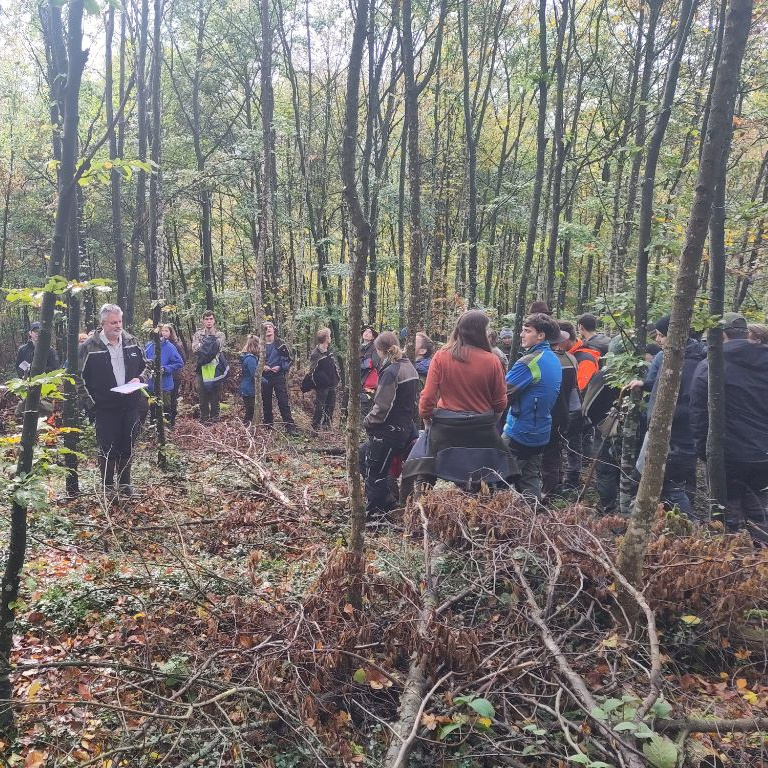
If you ask the students how they imagine the forest in 50 or 100 years' time, they all agree: where possible, the beech and oak trees that dominate today will still be found. But they are under no illusions. In locations where these trees are already struggling today, other tree species are needed. Local district manager Steffen Frank had these to hand: "The beech trees have suffered a lot here in recent years," he said, referring to a forest stand in which most of the large beech trees have now died and were eventually felled.
The next generation of trees was already waiting in the wings under the old trees. In addition to beech trees, field maple, Norway maple and hornbeam have also spread of their own accord. "These are tree species that cope well with the rising temperatures," Frank noted. "However, if we don't intervene to regulate them, the mixed tree species will be overgrown by beech, which is currently even more competitive and grows faster." To prevent this, Frank has specifically promoted mixed tree species.
Rare native tree species are planted in trial areas
If the natural regeneration of climate-stable tree species cannot be used, they are planted. The rare native tree species wild service tree and speierling are then often used.
In order to further expand the range of tree species, alternative tree species such as hybrid walnut and tree hazel have also been planted in Frank's district in recent years. "However, so far only on a small area and under scientific supervision," he explained. Until the trees have proven that they fit well into the ecosystem and are able to cope with climate change, there will be no more small trial areas in the near future.