



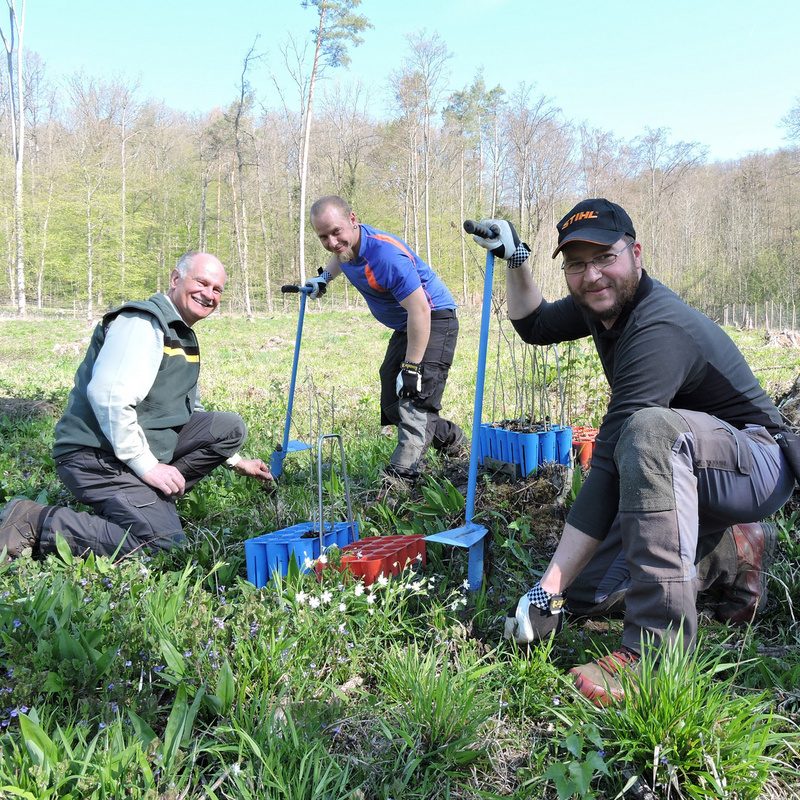
Arbor Day on Saturday, April 25, usually marks the end of the spring planting season in the Ludwigsburg district. In total, almost 50,000 young trees were planted throughout the district, which is roughly the same number as in previous years. The planting activities planned by many forest owners with school classes as part of forest education programs could not take place due to the coronavirus crisis, but will be carried out in the next planting season. The most frequently planted tree this spring was the oak, with 7,000 of the young trees alone finding a new home in the Vaihingen city forest. In addition, the foresters rely on a wide selection of different tree species, with particular consideration given to native, site-appropriate and drought-tolerant tree species. This year, hornbeams, Douglas firs, hazel, sweet chestnuts and wild serviceberries, among others, have found their way into the district's forests alongside oaks. In the Vaihingen forest, the 7,000 oaks are also accompanied by hornbeams, birches, bird cherries, Douglas firs and the rare fluttering elms. New tree species such as tulip trees and cedars have also been introduced on a trial basis.
The summers of 2018 and 2019 as well as the storm "Sabine" at the beginning of this year have left their mark on the Vaihingen municipal forest and the forests of other forest owners in the Ludwigsburg district. The spruce trees were hit the hardest, but beech and pine trees also suffered greatly from the drought. In the forest areas where no or no suitable young trees grow naturally, the forests can only be adapted by planting. The gaps in the forest caused by storms and drought are then closed by planting suitable tree species. These investments are absolutely necessary if the forest is to be preserved and made fit for the climate. "The bark beetle and the consequences of several years of drought will keep us busy for a long time this year," says Dr. Michael Nill, Head of the Forestry Department, adding: "We are now making the best of the situation and planting climate-stable tree species in the clear areas created by the storm and bark beetle."
Vaihingen's forestry workers have now taken on the challenge of planting the 7,000 oaks and 6,000 mixed tree species in the forest floor in a timely and professional manner. "We rely on oak trees here in the municipal forest, as they have coped best with the heat and drought in recent years. Its proverbial stability is based on its deep root system, which not only ensures stability, but also secures the water supply during longer dry periods," explains district forester Riedinger. "Now we are eagerly hoping for rain so that the young trees can survive their first few weeks with us!"