



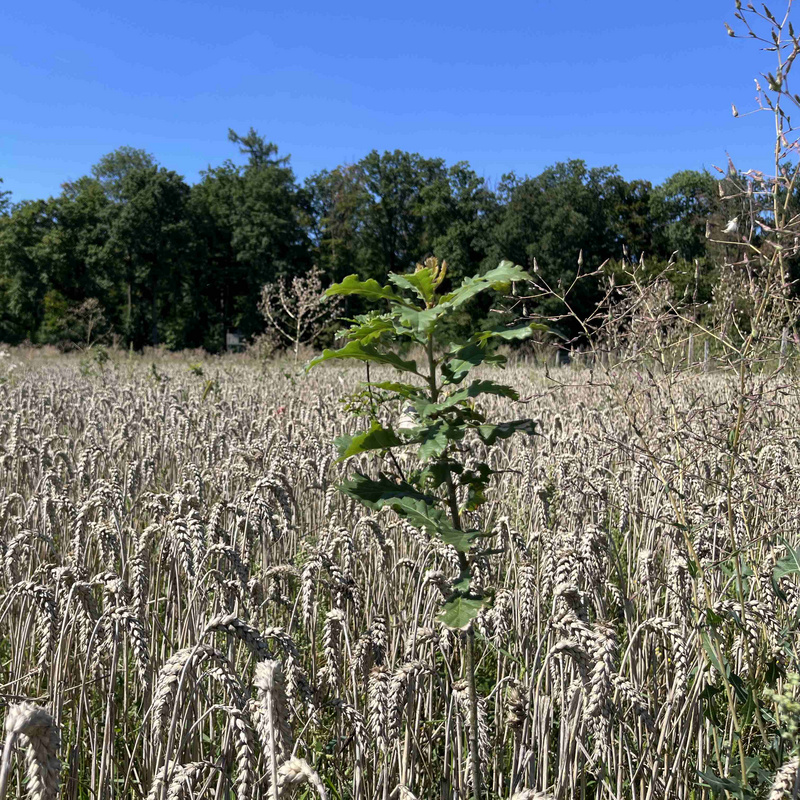
Part of the area, almost 1.2 hectares, was planted by the Stuttgart Regional Council as compensation under nature conservation law for the Heimerdingen bypass. However, the towns of Hemmingen and Ditzingen have voluntarily made the larger part of the area available for forest propagation in order to create long-term ecological added value.
A total of 13,310 trees and shrubs were planted. These included sessile oaks, hornbeams, winter lime trees, service trees, spireas, wild pears and various types of shrubs such as dogwood, honeysuckle, snowball, coneflower and dog rose. In addition, 990 meters of protective fencing were erected to secure the young plantations.
The reforestation was accompanied by targeted site preparation to ensure optimal establishment of the vegetation. The deliberate selection of site-appropriate, climate-stable tree species enables long-term management of forest development and actively contributes to climate adaptation and the promotion of biodiversity.
"Investing in the future of our forest"
The reforestation of agricultural land is a rarity in the sparsely wooded district of Ludwigsburg. It is therefore all the more pleasing that this measure not only creates ecological added value, but also makes a valuable contribution to CO₂ sequestration and stabilizing the local climate.
"This planting is more than just compensation - it is an investment in the future of our forest and our region," emphasizes district manager Steffen Frank. The forest manager planned the planting area and supervised the planting process as part of the afforestation on behalf of the Ludwigsburg district office.
In the coming years, the young trees will be intensively cared for in order to ensure their growth and allow a climate-stable mixed forest to develop.