



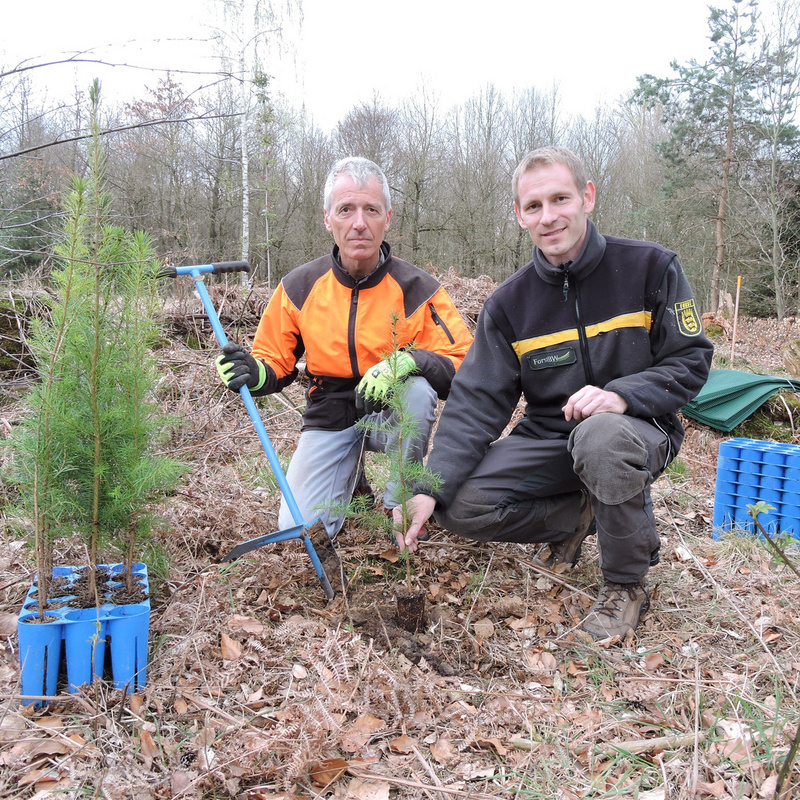
"We want to protect and preserve our forest. We need to prepare the forest for the challenges of the future and we are laying the foundations for this by planting oaks and Douglas firs. Our aim is to create climate-stable and species-rich forests for the generations of tomorrow and beyond," says district forester Simon Walz.
The fact that these investments are necessary in order to meet current and future challenges is currently evident in the late effects of the summer drought of 2018, which also left clear traces in the Gerlingen municipal forest. "Unfortunately, we also have to expect considerable damage throughout the district this year due to the bark beetle and the consequences of last year's drought," says Dr. Michael Nill, Deputy Head of the Forestry Department at the Ludwigsburg District Office. Spruce trees are particularly badly affected by the damage, but beech and pine trees are also struggling with the consequences of the drought, especially on the dry hilltops in Stromberg. "We have to take the initiative now," continued Nill. "We can make our forests fit for climate change by planting climate-stable tree species in the areas that have been damaged. Climate change is progressing faster than our tree species can adapt. This is why forest conversion to climate-stable mixed forests must take place in places through planting," explains district forester Walz.
The experts' hopes are pinned on oak and Douglas fir. For the first time this year, some cedars and hazel trees will also be planted in the city forest. This will increase the stability of the forest and its climate tolerance. This year, Gerlingen's forestry workers are planting a total of 500 oaks and 2,000 Douglas firs as well as a smaller number of cedars, tree hazel and other mixed tree species. The oak has many characteristics that could prove valuable in times of climate change. It has deep roots and can therefore usually reach enough water to survive even in dry years. At the same time, the deep roots ensure that the oak is more resistant to storms than other shallow-rooted tree species, such as spruce. The Douglas fir has similar positive characteristics, which makes this tree species, originally native to North America, a promising conifer. Compared to some other conifers, the Douglas fir is much more drought-resistant and can also withstand periods of poor water supply. Experts also expect a significant increase in drought resistance and heat tolerance from Atlas and Lebanon cedar and tree hazel. These tree species are seen as possible alternatives, especially in difficult locations where our native tree species will have major problems in times of dry and hot summers.