



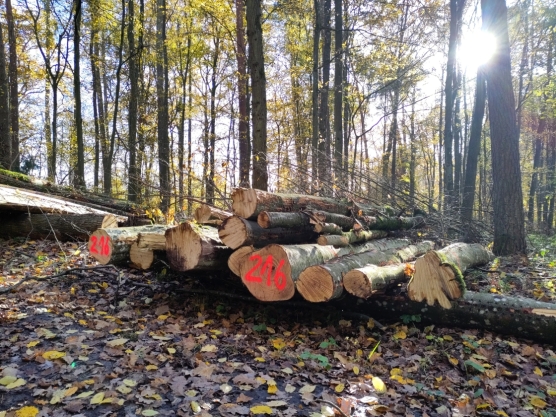
Firewood is a byproduct of sustainable forest management and maintenance. During thinning operations and measures to ensure public safety, for example, weakened trees are removed or individual trees are thinned out so they can grow better. The goal is to promote structurally diverse mixed forests and make the forest more resilient to climate change.
Firewood as a Byproduct of Forest Management
Not all harvested wood is suitable for durable, high-quality products such as furniture. Therefore, crown sections, small-diameter trunks, or wood with quality defects are used as firewood. The amount of firewood available depends on the planned forest management measures and the removal of forest damage.
From beech to oak: Firewood from local forests
In general, both hardwoods—including soft and hard deciduous woods—and softwoods are suitable as fuel. Hard deciduous woods typically provide more heat per cubic meter than soft deciduous woods. Hardwoods include beech, oak, and ash, which have similarly high heating values. Since there are many deciduous forests in the Ludwigsburg district, these species are among the most commonly available firewoods.
The different types of wood vary, among other things, in how easily they ignite, how long they burn, and how much smoke they produce. Their heating values, flame patterns, and scents also vary. Which type of wood is best suited therefore depends on the intended use and personal preferences.
Dates and Information on Buying Firewood
The dates and details regarding firewood auctions in the municipalities of the district can be found on the Forestry Department’s website:
www.landkreis-ludwigsburg.de/de/umwelt-technik-klimaschutz/wald/brennholz
Anyone wishing to participate in an auction must provide proof of completion of a chainsaw training course.
Most municipalities offer both firewood stacks and standing timber lots. Stacks consist of wood that has already been processed and stacked along a forest road. Depending on the offering, it is sold by solid cubic meters or cubic meters. Stands of timber consist of fallen wood within a designated forest area that buyers must process themselves. They are usually less expensive than stacks but require more work.
When processing firewood and standing timber, your own safety and the required protective clothing are particularly important.