



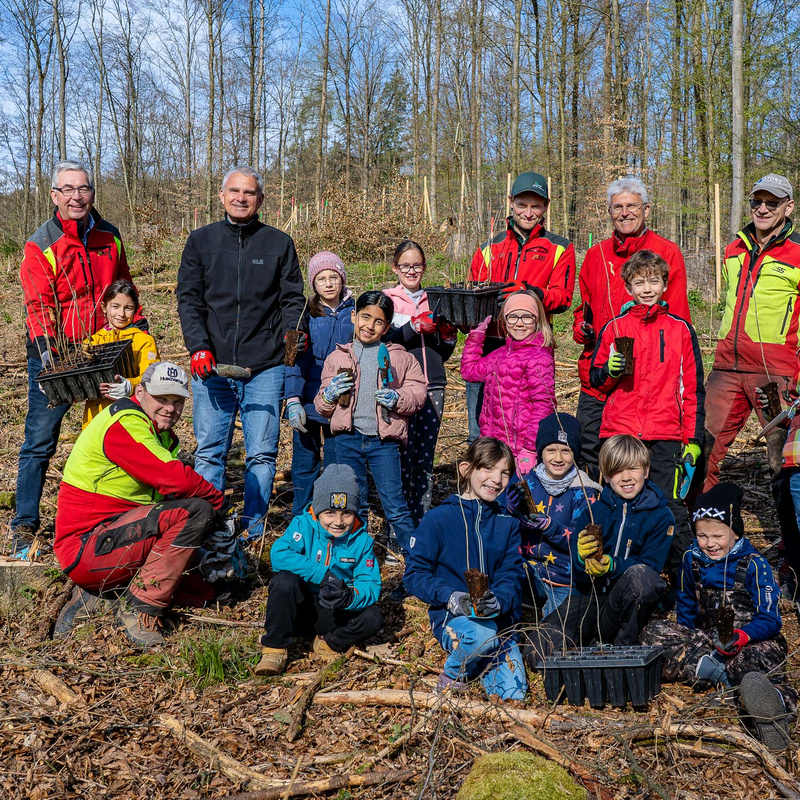
A total of around 300 trees, including 200 bird cherries and 100 red oaks, were planted on two days of action with pupils from classes 3a and 3b in Hohenhaslach under the guidance of the forestry department. The planting campaign is intended to give the pupils an understanding of the importance of forests for society in general and for climate protection in particular and to contribute to the creation of a sustainable, climate-stable and near-natural mixed forest. The original stand of spruce and Douglas fir trees in the planting area was partially destroyed by the storm "Sabine" in February 2020.
Tree planting campaigns essential for climate-resistant forests of tomorrow
"Tree planting campaigns like these are small but crucial measures for climate adaptation in our forests in the district," said District Administrator Dietmar Allgaier. The forest is currently undergoing massive change, and conifers will only have a very limited future. Instead, more climate-resistant species such as oaks, hornbeams, cherries, field and Norway maples and wild service trees will continue to gain in importance. Drought damage and, as a result, beetle and fungal infestations are still at a very high level after the record values from 2018 in the entire forest stand.
County on trend: red oak is tree of the year 2025
The red oak was voted Tree of the Year 2025 by a panel of experts last fall. Originally from North America, the tree species is hardy and relatively climate-resistant. "The red oak can also tolerate higher temperatures. It can therefore be an alternative to our native, naturally regenerating tree species, particularly in locations with a moderate water supply. To spread the risk, however, it is always planted in combination with at least one other tree species, such as the cherry here," says Dr. Simon Boden, Head of the Forestry Department at the District Office. The proportion of red oak in the Sachsenheim municipal forest, together with the group of other deciduous trees and more than 20 species, is around three percent of the forest area.