



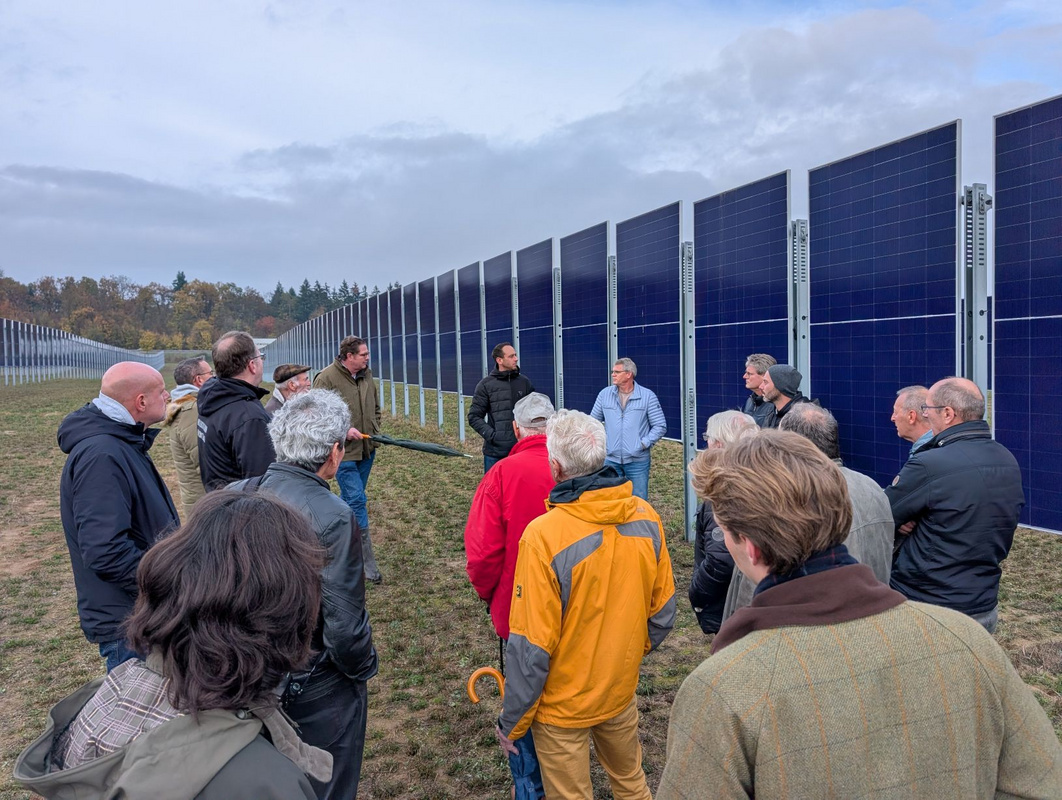
The event was hosted by the Ludwigsburg District Energy Agency, the Stuttgart Region PV Network, the Solaroffensive, and the Ludwigsburg District Administration. An informational event on agri-PV had already taken place in February 2025. The field trip to Bad Rappenau now gave farmers a practical look at the technology. There are currently no agri-PV systems in the Ludwigsburg district. Given the region’s high-quality soil and significant electricity demand, agri-PV plays an important role in reducing land-use conflicts.
Vertical modules generate electricity during peak demand times
Vertical solar modules with a capacity of 5,450 kilowatt-peak are installed on approximately 24 hectares in Bad Rappenau-Fürfeld. They generate electricity primarily in the morning and afternoon, extending into the evening—when demand is particularly high. This amounts to approximately six gigawatt-hours of electricity annually—enough to power about 2,170 households. There is a 13.6-meter spacing between each row of modules. Grain cultivation is planned for these areas in the future. Flower strips are to be created directly beneath the panels. Parts of the farm’s operations are GPS-controlled.
Farmer Michael von Gemmingen and Florian Oeß, deputy chairman of the board of the Kraichgau Citizens’ Energy Cooperative, provided insights into the project. It was developed jointly by the farmer and the cooperative. A long-term power purchase agreement with agricultural equipment manufacturer John Deere guarantees the purchase of the electricity generated. As a result, the plant does not require government subsidies.
Considering Economic Viability Early On
The topic of economic viability was discussed in particular depth. A key insight: Anyone planning an agri-PV project should clarify early on who will purchase the electricity in the long term, as construction costs are higher than for traditional PV parks. A suitable power purchase agreement can be a crucial component of the project’s economic viability.